


Page 28 - Vol 7 No 3 July September 2017
P. 28
PESY: Print ISSN 2231-1394, Online ISSN 2278-795X                                                                              Vol. 7 No 3

                                                           TABLE-I
                             THE RESULTS OF ANALYSIS OF COVARIANCE ON AGILITY
                                                  OF DIFFERENT GROUPS
                                                      (Scores in Seconds)
                                               G- 2
                                      G- 1                G- 3                                        ‘F’
                   Test Conditions             LI-                  SV         SS       Df  MS
                                      LI-PT               CG                                          Ratio
                                               PTAT
                              Mean  12.98      12.91      12.9      Between  0.47       2     0.023
                   Pre test                                                                           0.97
                              S.D.    0.36     0.51       0.57      Within     6.463    27  0.239
                              Mean  11.92      11.77      13.38     Between  15.82      2     7.908
                   Post test                                                                          31.12*
                              S.D.    0.35     0.42       0.68      Within     6.86     27  0.254
                   Adjusted   Mean  11.90      11.79      13.39     Between  16.23      2     8.11    39.29*
                   post test                                        Within     5.37     26  0.21
                 * Significant at .05 level of confidence. The required table’s value for test the significance was
                 3.35 and 3.37, with the df of 2 and 27, 2 and 26.

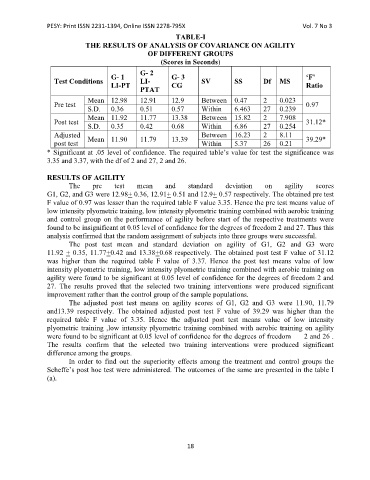
                 RESULTS OF AGILITY
                        The     pre    test   mean      and    standard     deviation    on    agility   scores
                 G1, G2, and G3 were 12.98+ 0.36, 12.91+ 0.51 and 12.9+ 0.57 respectively. The obtained pre test
                 F value of 0.97 was lesser than the required table F value 3.35. Hence the pre test means value of
                 low intensity plyometric training, low intensity plyometric training combined with aerobic training
                 and  control  group  on  the  performance  of  agility  before  start  of  the  respective  treatments  were
                 found to be insignificant at 0.05 level of confidence for the degrees of freedom 2 and 27. Thus this
                 analysis confirmed that the random assignment of subjects into three groups were successful.
                        The  post  test  mean  and  standard  deviation  on  agility  of  G1,  G2  and  G3  were
                 11.92 + 0.35, 11.77+0.42 and 13.38+0.68 respectively. The obtained post test F value of 31.12
                 was  higher  than  the  required  table  F  value  of  3.37.  Hence  the  post  test  means  value  of  low
                 intensity plyometric training, low intensity plyometric training combined with aerobic training on
                 agility were found to be significant at 0.05 level of confidence for the degrees of freedom 2 and
                 27.  The  results  proved  that  the  selected  two  training  interventions  were  produced  significant
                 improvement rather than the control group of the sample populations.
                        The  adjusted  post  test  means  on  agility  scores  of  G1,  G2  and  G3  were  11.90,  11.79
                 and13.39  respectively.  The  obtained  adjusted  post  test  F  value  of  39.29  was  higher  than  the
                 required  table  F  value  of  3.35.  Hence  the  adjusted  post  test  means  value  of  low  intensity
                 plyometric training ,low intensity plyometric training combined with aerobic training on agility
                 were found to be significant at 0.05 level of confidence for the degrees of freedom      2 and 26 .
                 The  results  confirm  that  the  selected  two  training  interventions  were  produced  significant
                 difference among the groups.
                        In  order  to  find  out  the  superiority  effects  among  the  treatment  and  control  groups  the
                 Scheffe’s post hoc test were administered. The outcomes of the same are presented in the table I
                 (a).


                                                               18

