


Page 29 - Vol 7 No 3 July September 2017
P. 29
PESY: Print ISSN 2231-1394, Online ISSN 2278-795X                                                                              Vol. 7 No 3

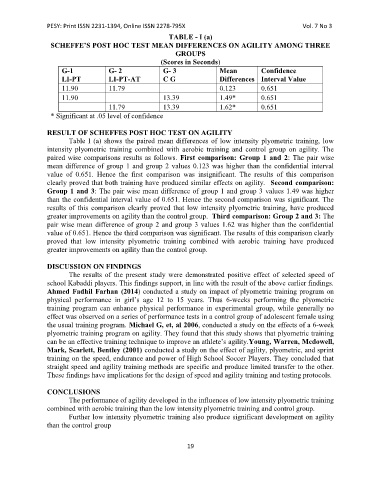
                                                         TABLE - I (a)
                  SCHEFFE’S POST HOC TEST MEAN DIFFERENCES ON AGILITY AMONG THREE
                                                           GROUPS
                                                      (Scores in Seconds)
                     G-1             G- 2              G- 3               Mean         Confidence
                     LI-PT           LI-PT-AT          C G                Differences  Interval Value
                     11.90           11.79                                0.123        0.651
                     11.90                             13.39              1.49*        0.651
                                     11.79             13.39              1.62*        0.651
                   * Significant at .05 level of confidence

                 RESULT OF SCHEFFES POST HOC TEST ON AGILITY
                        Table I  (a) shows the paired mean differences  of low intensity plyometric training, low
                 intensity  plyometric  training  combined  with  aerobic  training  and  control  group  on  agility.  The
                 paired wise comparisons results as follows.  First  comparison:  Group  1  and  2: The pair wise
                 mean difference of group 1 and group 2 values 0.123 was higher than the confidential interval
                 value  of  0.651.  Hence  the  first  comparison  was  insignificant.  The  results  of  this  comparison
                 clearly proved that both training have produced similar effects on agility.  Second comparison:
                 Group 1 and 3: The pair wise mean difference of group 1 and group 3 values 1.49 was higher
                 than the confidential interval value of 0.651. Hence the second comparison was significant. The
                 results  of this  comparison  clearly  proved  that  low  intensity plyometric training,  have produced
                 greater improvements on agility than the control group.  Third comparison: Group 2 and 3: The
                 pair wise mean difference of group 2 and group 3 values 1.62 was higher than the confidential
                 value of 0.651. Hence the third comparison was significant. The results of this comparison clearly
                 proved  that  low  intensity  plyometric  training  combined  with  aerobic  training  have  produced
                 greater improvements on agility than the control group.

                 DISCUSSION ON FINDINGS
                        The  results  of  the  present  study  were  demonstrated  positive  effect  of  selected  speed  of
                 school Kabaddi players. This findings support, in line with the result of the above earlier findings.
                 Ahmed Fadhil Farhan  (2014) conducted a study on impact of plyometric training program on
                 physical  performance  in  girl’s  age  12  to  15  years.  Thus  6-weeks  performing  the  plyometric
                 training  program  can  enhance  physical  performance in  experimental  group,  while  generally  no
                 effect was observed on a series of performance tests in a control group of adolescent female using
                 the usual training program. Michael G, et, al 2006, conducted a study on the effects of a 6-week
                 plyometric training program on agility. They found that this study shows that plyometric training
                 can be an effective training technique to improve an athlete’s agility.Young, Warren, Mcdowell,
                 Mark, Scarlett, Bentley (2001) conducted a study on the effect of agility, plyometric, and sprint
                 training on the speed, endurance and power of High School Soccer Players. They concluded that
                 straight speed and agility training methods are specific and produce limited transfer to the other.
                 These findings have implications for the design of speed and agility training and testing protocols.

                 CONCLUSIONS
                        The performance of agility developed in the influences of low intensity plyometric training
                 combined with aerobic training than the low intensity plyometric training and control group.
                        Further low intensity plyometric training also produce significant development on agility
                 than the control group


                                                               19

