


Page 180 - Player's Handbook
P. 180
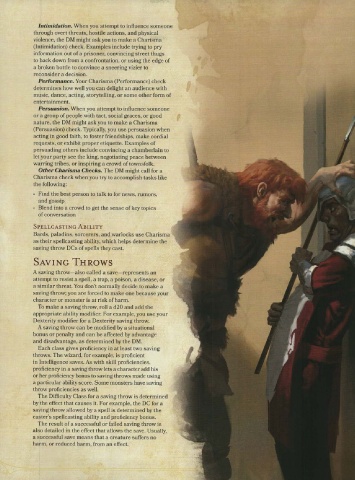
Intimidation. When you attempt to influence someone
            through overt threats, hostile actions, and physical
            violence, the DM might ask you to make a Charisma
            (Intimidation) check. Examples include trying to pry
            information out of a prisoner, convincing street thugs
            to back down from a confrontation, ar using the edge of
            a broken bottle to convince a sneering vizier to
            reconsider a decision.
             Performance. Your Charisma (Performance) check
            determines how well you can delight an audience with
            music, dance, acting, storytelling, ar some other form of
            entertainment.
             Persuasion. When you attempt to influence someone
            or a group of people with tact. social graces, ar good
            nature, the DM might ask you to make a Charisma
            (Persuasion) check. Typically, you use persuasion when
            acting in good faith, to foster friendships, make cordial
            requests, ar exhibit proper etiquette. Examples of
            persuading others include convincing a chamberlain to
            let your party see the king, negotiating peace between
            warring tribes, ar inspiring a crowd of townsfolk.
             Other Charisma Checks. The DM might call for a
            Charisma check when you try to accomplish tasks like
            the following:
              Find the best person to talk to for news, rumors,
             and gossip
             Blend into a crowd to get the sense of key topics
             of conversation

            SPELLCASTING  ABILITY
            Bards, paladins, sorcerers. and warlocks use Charisma
            as their spellcasting ability, which helps determine the
            saving throw DCs of spells they cast.
            SAVING THROWS

            A saving throw-also  called a save-represents  an
            attempt to resist a spell, a trap, a poison, a disease, ar
            a similar threat. Vou don't normally decide to make a
            saving throw; you are forced to make one because your
            character ar monster is at risk of harm.
             To make a saving throw, roll a d20 and add the
            appropriate ability modifier. For example, you use your
            Dexterity modifier for a Dexterity saving throw.
             A saving throw can be modified by a situational
            bonus ar penalty and can be affected byadvantage
            and disadvantage, as determined by the DM.
             Each class gives proficiency in at least two saving
            throws. The wizard, for example, is proficient
            in Intelligence saves. As with skill proficiencies,
            proficiency in a saving throw lets a character add his
            ar her proficiency bonus to saving throws made using
            a particular ability score. Some monsters have saving
            throw proficiencies as well.
             The Difficulty Class for a saving throw is determined
            by the effect that causes it. For example, the DC for a
            saving throw allowed bya spell is determined by the
            caster's spellcasting ability and proficiency bonus.
             The result of a successful ar failed saving throw is
            also detailed in the effeel that allows the save. Usually,
            a successful save means that a creature suffers no
            harm, ar reduced harm, from an effect.

