


Page 260 - Math Smart - 7
P. 260
O Use the graph to find 16 km on the vertical axis.
                                          Follow the red dotted line to the right to go to the straight-line graph.
                                          Then draw a blue dotted line to go down to find the corresponding value on
                                          the horizontal axis.
                                          16 km = 10 mi.

                                      O Use the graph to find 28 km on the vertical axis.
                                          Follow the red dotted line to the right to go to the straight-line graph.
                                          Then draw a blue dotted line to go down to find the corresponding value on
                                          the horizontal axis.
                                          28 km = 17.5 mi.


                                         .4.2 Wages chart


                                      Straight line graphs are useful to track one quantity against another quantity that
                                      changes proportionally to each other.

                                       Example 2


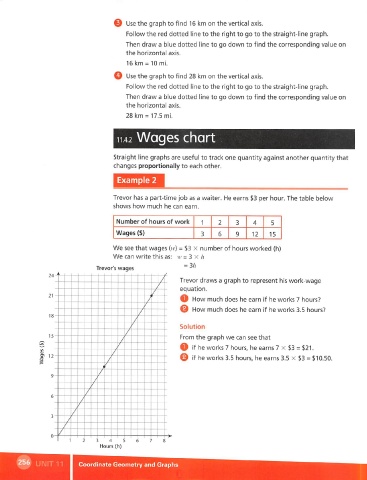
                                      Trevor has a part-time job as a waiter. He earns $3 per hour. The table below
                                      shows how much he can earn.

                                       Number of hours of work    1    2     3     4    5

                                       Wages {$)                  3    6     9    12    15

                                      We see that wages (w) = $3 x number of hours worked (h)
                                      We can write this as:  u- = 3 x h
                                                            = 3/7
                                Trevor's wages
                 24
                                                           Trevor draws a graph to represent his work-wage
                                                           equation.
                 21
                                                           O How much does he earn if he works 7 hours?
                                                           @ How much does he earn if he works 3.5 hours?
                                             0
                 18
                                           0
                                                           Solution
                                         0
                 15                                        From the graph we can see that
                                      /
                                                               if
                                                           O he works 7 hours, he earns 7 x $3 = $21.
              a>
             I 12-                  /                      © if he works 3.5 hours, he earns 3.5 x $3 = $10.50.


                            0
                          0
                       0


                                3
                                 Hours (h)


                          Coordinate Geometry and Graphs

