


Page 433 - Math Smart - 7
P. 433
The more times this experiment is conducted, the more accurate the estimated
         probability of rolling each number will be. If the experimental probabilities of
         every group are far from what you would expect, then you can say that the
         die may be biased.
                                                                                     J


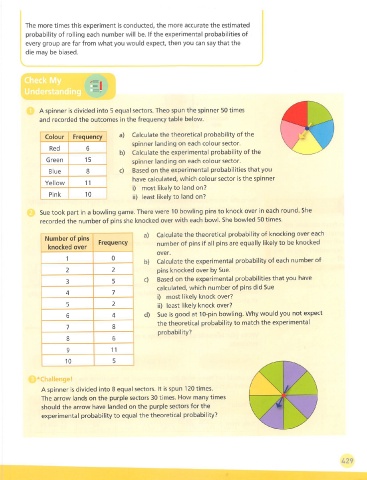
              A spinner is divided into 5 equal sectors. Theo spun the spinner 50 times
              and recorded the outcomes in the frequency table below.


                Colour   Frequency      a)  Calculate the theoretical probability of the
                                            spinner landing on each colour sector.
                 Red         6
                                        b)  Calculate the experimental probability of the
                Green       15              spinner landing on each colour sector.
                 Blue        8          c)  Based on the experimental probabilities that you
                                            have calculated, which colour sector is the spinner
                Yellow      11
                                            i)  most likely to land on?
                 Pink       10              ii)  least likely to land on?

              Sue took part in a bowling game. There were 10 bowling pins to knock over in each round. She
              recorded the number of pins she knocked over with each bowl. She bowled 50 times.

                                                a) Calculate the theoretical probability of knocking over each
                Number of pins
                                 Frequency          number of pins if all pins are equally likely to be knocked
                knocked over
                                                    over.
                                     0       '
                      1
                                                b) Calculate the experimental probability of each number of
                      2              2              pins knocked over by Sue.
                                                    Based on the experimental probabilities that you have
                      3              5
                                                    calculated, which number of pins did Sue
                      4              7
                                                    i)  most likely knock over?
                      5              2              ii)  least likely knock over?

                      6              4          d)  Sue is good at 10-pin bowling. Why would you not expect
                                                    the theoretical probability to match the experimental
                      7              8
                                                    probability?
                      8              6

                      9              11
                      10             5

             *Cha!len9G!
              A spinner is divided into 8 equal sectors. It is spun 120 times.
              The arrow lands on the purple sectors 30 times. How many times
              should the arrow have landed on the purple sectors for the
              experimental probability to equal the theoretical probability?


                                                                                                                429

