


Page 75 - Elementary Algebra Exercise Book I
P. 75
ELEMENTARY ALGEBRA EXERCISE BOOK I                                               equAtions


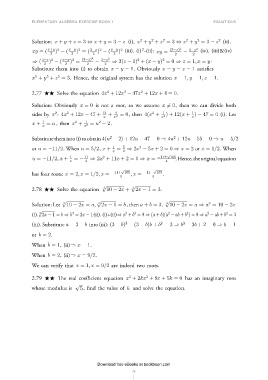
               Solution:  x + y + z =3 ⇔ x + y =3 − z  (i),  x + y + z =3 ⇔ x + y =3 − z  (ii).
                                                                                    2
                                                                                         2
                                                                                                  2
                                                               2
                                                                    2
                                                                         2
                                                      )  (iii). (i) -(ii):
               xy =(  x+y 2     x−y 2    3−z 2    x−y 2         2      xy =  (3−z) 2  −  3−z 2  (iv). (iii)&(iv)
                                   ) =(
                                            ) − (
                          ) − (
                       2         2        2        2                           2       2
                                                              2
                                                                         2
                       ) − (
               ⇒ (  3−z 2    x−y 2   (3−z) 2  −  3−z 2  ⇒ 3(z − 1) +(x − y) =0 ⇒ z =1,x = y    .
                                ) =
                     2        2         2      2
               Substitute them into (i) to obtain  x = y =1. Obviously  x = y = z =1 satisfies
               x + y + z =3. Hence, the original system has the solution  x =1,y =1,z =1.
                 5
                           5
                      5
               2.77     Solve the equation  4x + 12x − 47x + 12x +4 = 0.
                                                 4
                                                        3
                                                                2
               Solution: Obviously  x =0 is not a root, so we assume  x  =0, then we can divide both
                                                                                      1
                               2
                         2
                                                                     2
               sides by  x :  4x + 12x − 47 +  12  +  4 2 =0, then  4(x +  1 2 ) + 12(x + ) − 47 = 0 (i). Let
                                               x    x                    x            x
                                             2
                                  2
               x +  1  = u , then  x +  1 2 = u − 2.
                    x                 x
               Substitute them into (i) to obtain 4(u − 2) + 12u − 47 = 0 ⇒ 4u + 12u − 55 = 0 ⇒ u =5/2
                                                                              2
                                                  2
                                                               2
               or u = −11/2. When u =5/2, x +      1  =  5  ⇒ 2x − 5x +2 = 0 ⇒ x =2 or x =1/2. When
                                                   x    2
                                                                           √
                                               2
               u = −11/2, x +   1  = − 11  ⇒ 2x + 11x +2 = 0 ⇒ x =     −11± 105 . Hence, the original equation
                                x      2                                   4
                                                       √             √
               has four roots: x =2,x =1/2,x =     −11+ 105 ,x =  −11− 105 .
                                                      4              4
                                              √            √
               2.78     Solve the equation     3  10 − 2x +  3  2x − 1= 3.
                             √              √                             √
                                                                           3
                                                                                              3
                             3
               Solution: Let  10 − 2x = a,   3  2x − 1= b , then a + b =3.  10 − 2x = a ⇒ a = 10 − 2x
                  √
               (i).  2x − 1= b ⇒ b =2x − 1 (ii). (i)+(ii)⇒ a + b =9 ⇒ (a + b)(a − ab + b ) =9 ⇒ a − ab + b =3
                                                                                    2
                                                                            2
                                 3
                                                         3
                                                                                                     2
                   3
                                                                                             2
                                                             3
                                                         2
                                                                                  2
                                                                        2
               (iii). Substitute a =3 − b  into (iii): (3 − b) − (3 − b)b + b =3 ⇒ b − 3b +2 = 0 ⇒ b =1
               or  b =2.
               When  b =1, (ii)⇒ x =1.
               When  b =2, (ii)⇒ x =9/2.
               We can verify that  x =1,x =9/2 are indeed two roots.
                                                          3
                                                                  2
               2.79     The real coefficient equation  x +2kx +9x +5k =0 has an imaginary root
                                  √
               whose modulus is      5, find the value of  k  and solve the equation.


                                            Download free eBooks at bookboon.com
                                                            75

