Page 80 - Elementary Algebra Exercise Book I
P. 80
ELEMENTARY ALGEBRA EXERCISE BOOK I                                               equAtions


                                                                              x
                                             2
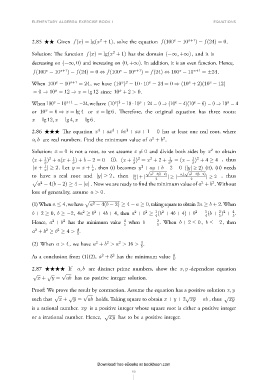
               2.85     Given  f(x) =lg(x + 1), solve the equation  f(100 − 10       x+1 ) − f(24) = 0.
               Solution: The function  f(x) =lg(x + 1) has the domain  (−∞, +∞), and it is
                                                   2
               decreasing on (−∞, 0) and increasing on (0, +∞). In addition, it is an even function. Hence,

                                                                                 x
                     x
                                                      x
                f(100 − 10  x+1 ) − f(24) = 0 ⇔ f(100 − 10   x+1 )= f(24) ⇔ 100 − 10   x+1  = ±24.
                                                                                                                x
                                                                   x
                                                                                     x
                                                                                              x
                                                       x 2
                          x
               When  100 − 10   x+1  = 24, we have  (10 ) − 10 · 10 − 24 = 0 ⇒ (10 + 2)(10 − 12) = 0 ⇒ 10 = 12 ⇒ x = lg 12
 (10 ) − 10 · 10 − 24 = 0 ⇒ (10 + 2)(10 − 12) = 0 ⇒ 10 = 12 ⇒ x = lg 12 since  10 +2 > 0.
                                                      x
 x
 x
 x 2
                         x
        x
                                                    x 2
                                                               x
                         x
                                                                                                      x
                                                                                       x
                                                                               x
               When 100 − 10   x+1  = −24, we have  (10 ) − 10 · 10 + 24 = 0 ⇒ (10 − 4)(10 − 6) = 0 ⇒ 10 =4
               or  10 =6 ⇒ x = lg 4  or  x = lg 6. Therefore, the original equation has three roots:
                     x
               x = lg 12,x = lg 4,x = lg 6.
               2.86      The equation  x + ax + bx + ax +1 = 0 has at least one real root, where
                                                         2
                                                   3
                                             4
               a, b  are real numbers. Find the minimum value of  a + b .
                                                                         2
                                                                     2
               Solution:  x =0 is not a root, so we assume  x  =0 and divide both sides by  x  to obtain
                                                                                               2
                                 1
                                                                    2
                                                            1 2
                                                                                      1 2
                     1 2
               (x + ) + a(x + )+ b − 2= 0  (i).  (x + ) = x +2+             1 2 =(x − ) +4 ≥ 4 , thus
                     x           x                          x               x         x
                                          1
                     1
                |x + |≥ 2. Let  y = x + , then (i) becomes  y + ay + b − 2= 0  (|y|≥ 2) (ii). (ii) needs
                                                                2
                     x                    x                       √                √
                                                                                      2
                                                                     2
                                                             a      a −4(b−2)   −a±  a −4(b−2) |≥ 2 , thus
               to have a real root and  |y|≥ 2 , then  | | + |             | ≥|
                                                             2        2               2

                  a − 4(b − 2) ≥ 4 −|a| . Now we are ready to find the minimum value of a + b . Without
                                                                                               2
                   2
                                                                                          2
               loss of generality, assume  a> 0.

               (1) When a ≤ 4, we have   a − 4(b − 2) ≥ 4 − a ≥ 0, taking square to obtain 2a ≥ b +2. When
                                          2
                                                                      1
               b +2 ≥ 0,  b ≥−2,  4a ≥ b +4b +4, then  a + b ≥ (b +4b + 4) + b = (b + ) + .
                                                                                            5
                                                                                                        4
                                                                         2
                                                             2
                                      2
                                                                  2
                                           2
                                                                                                  2 2
                                                                                        2
                                                                      4                     4     5     5
                                                        4
               Hence,  a + b  has the minimum value   when  b = − . When  b +2 ≤ 0 ,  b ≤−2, then
                                                                       2
                        2
                             2
                                                        5              5
                                   4
               a + b ≥ b ≥ 4 > .
                     2
                           2
                 2
                                   5
               (2) When  a> 4, we have  a + b >a > 16 > .
                                                                4
                                                2
                                                      2
                                            2
                                                                5
               As a conclusion from (1)(2),  a + b  has the minimum value  .
                                                                              4
                                                   2
                                              2
                                                                              5
               2.87       If   a, b  are distinct prime numbers, show the  x, y -dependent equation
                √     √     √
                  x +   y =   ab  has no positive integer solution.
               Proof: We prove the result by contraction. Assume the equation has a positive solution x, y
                         √      √     √                                            √                 √
               such that   x +    y =   ab  holds. Taking square to obtain x + y +2 xy = ab , thus     xy
               is a rational number.  xy  is a positive integer whose square root is either a positive integer
               or a irrational number. Hence,   √ xy  has to be a positive integer.
                                            Download free eBooks at bookboon.com
                                                            80
   75   76   77   78   79   80   81   82   83   84   85