


Page 103 - Basic Principles of Textile Coloration
P. 103
92 ARTIFICIALLY MADE FIBRES BASED ON CELLULOSE

CHAPTER 6

Artificially made fibres based on cellulose

6.1 THE FIRST REGENERATED CELLULOSE FIBRES
The first artificially made filaments of regenerated cellulose were produced by
Chardonnet in 1884. These were named artificial silk because of their form and
appearance. The production method involved extrusion of a solution of cellulose
nitrate and regeneration of the cellulose by hydrolysis, as outlined in Section 1.1.2.
Although this fibre was produced commercially until 1949, the quantity was
always limited by the difficulties of controlling the reactions involved and the high
flammability of nitrocellulose and the solvents used. Nevertheless, Chardonnet
was the first to demonstrate that extrusion of a polymer solution and evaporation
of the solvent, a technique now called dry spinning, was a feasible method of fibre
production on a large scale.

   Cuprammonium viscose (then called cuprammonium rayon) was first
manufactured commercially in 1899. According to the US Federal Trade
Commission, a rayon (viscose) is a fibre of regenerated cellulose in which other
substituents have replaced not more than 15% of the hydroxyl groups.
Cuprammonium viscose is also called cupro or Bemberg viscose. Purified cotton
linters, or wood pulp, are dissolved in a solution of cuprammonium hydroxide and
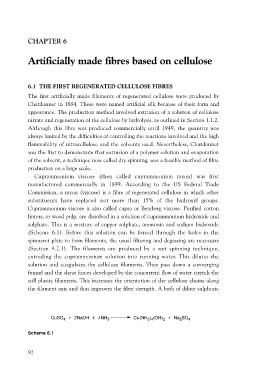
sulphate. This is a mixture of copper sulphate, ammonia and sodium hydroxide
(Scheme 6.1). Before this solution can be forced through the holes in the
spinneret plate to form filaments, the usual filtering and degassing are necessary
(Section 4.2.1). The filaments are produced by a wet spinning technique,
extruding the cuprammonium solution into running water. This dilutes the
solution and coagulates the cellulose filaments. They pass down a converging
funnel and the shear forces developed by the concurrent flow of water stretch the
still plastic filaments. This increases the orientation of the cellulose chains along
the filament axis and thus improves the fibre strength. A bath of dilute sulphuric

               CuSO4 + 2NaOH + 4NH3  Cu(NH3)4(OH)2 + Na2SO4
Scheme 6.1

92

