


Page 104 - Basic Principles of Textile Coloration
P. 104
VISCOSE FIBRE 93

acid washes out the remainder of the copper and neutralises the ammonia. Copper
salts are sufficiently expensive to make recovery and recycling of the copper
necessary. The filaments are finally well washed and dried.

   The smooth, round filaments of this viscose tend to adhere together so that
twisting is not necessary. This adhesive quality is used in forming slub yarns.
These have thicker areas along the even yarn consisting of an accumulated mass
of fibres. For these, the filaments running continuously from one spinneret are
intermittently combined with accumulated filaments from another, to produce
yarn with slubs. The physical and chemical properties of cuprammonium viscose
are very similar to those of viscose fibre discussed in the next section. Despite the
silky appearance, fine denier, soft handle and good draping properties of fabrics
made from it, cuprammonium viscose has always been a minor fibre compared to
regular viscose.

6.2 VISCOSE FIBRE [1,2]

6.2.1 Production of regular viscose fibre
Cross and Bevan in the UK discovered the viscose method for the production of
regenerated cellulose in 1892. This was later developed by Courtaulds Ltd. After
wet spinning of a dilute NaOH solution of the xanthate ester of cellulose into an
acidic spinning bath, the cellulose filaments reform by coagulation and hydrolysis
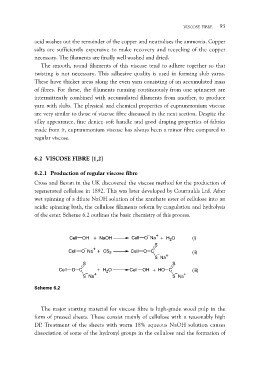
of the ester. Scheme 6.2 outlines the basic chemistry of this process.

            Cell OH + NaOH    Cell O Na + H2O                  (i)
                                             S                 (ii)
            Cell O Na + CS2                                    (iii)
                             Cell O C
            S                                S Na
                                                         S
Cell O C          + H2O
                             Cell OH + HO C
            S Na                                         S Na

Scheme 6.2

   The major starting material for viscose fibre is high-grade wood pulp in the
form of pressed sheets. These consist mainly of cellulose with a reasonably high
DP. Treatment of the sheets with warm 18% aqueous NaOH solution causes
dissociation of some of the hydroxyl groups in the cellulose and the formation of

