


Page 107 - Basic Principles of Textile Coloration
P. 107
Stress/cN tex –196 ARTIFICIALLY MADE FIBRES BASED ON CELLULOSE

                            60

                                                                        Wet cotton
                            40

                                                                        Dry cotton

                            20 Dry viscose staple

                                                                                Wet viscose staple

                             0
                                0 5 10 15 20
                                                                     Strain/%

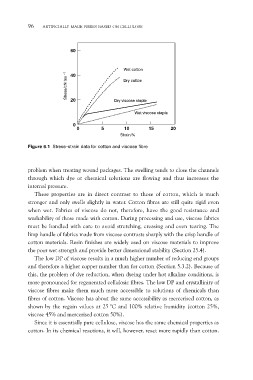
Figure 6.1 Stress–strain data for cotton and viscose fibre

problem when treating wound packages. The swelling tends to close the channels
through which dye or chemical solutions are flowing and thus increases the
internal pressure.

   These properties are in direct contrast to those of cotton, which is much
stronger and only swells slightly in water. Cotton fibres are still quite rigid even
when wet. Fabrics of viscose do not, therefore, have the good resistance and
washability of those made with cotton. During processing and use, viscose fabrics
must be handled with care to avoid stretching, creasing and even tearing. The
limp handle of fabrics made from viscose contrasts sharply with the crisp handle of
cotton materials. Resin finishes are widely used on viscose materials to improve
the poor wet strength and provide better dimensional stability (Section 25.4).

   The low DP of viscose results in a much higher number of reducing end groups
and therefore a higher copper number than for cotton (Section 5.3.2). Because of
this, the problem of dye reduction, when dyeing under hot alkaline conditions, is
more pronounced for regenerated cellulosic fibres. The low DP and crystallinity of
viscose fibres make them much more accessible to solutions of chemicals than
fibres of cotton. Viscose has about the same accessibility as mercerised cotton, as
shown by the regain values at 25 °C and 100% relative humidity (cotton 25%,
viscose 45% and mercerised cotton 50%).

   Since it is essentially pure cellulose, viscose has the same chemical properties as
cotton. In its chemical reactions, it will, however, react more rapidly than cotton.

