


Page 122 - Basic Principles of Textile Coloration
P. 122
STRUCTURE OF WOOL FIBRES 111

size and chemical nature and project outwards from the main polymer chain.
There are six main types:
(1) non-reactive hydrocarbon groups, as in alanine;
(2) polar groups such as alcoholic or phenolic groups, as in serine and tyrosine;
(3) basic groups, as in lysine, that influence the maximum amount of acid with

      which the wool combines and the absorption of anionic acid dyes (Section
      1.1.2)
(4) acidic groups, as in glutamic acid;
(5) covalent crosslinking groups, as in cystine, that influence the solubility,
      swelling and mechanical properties of wool;
(6) heterocyclic groups, as in proline.

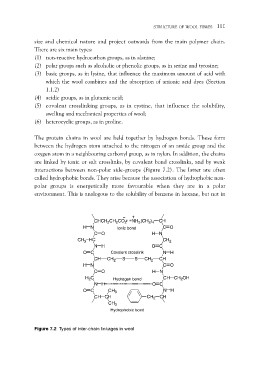
The protein chains in wool are held together by hydrogen bonds. These form
between the hydrogen atom attached to the nitrogen of an amide group and the
oxygen atom in a neighbouring carbonyl group, as in nylon. In addition, the chains
are linked by ionic or salt crosslinks, by covalent bond crosslinks, and by weak
interactions between non-polar side-groups (Figure 7.2). The latter are often
called hydrophobic bonds. They arise because the association of hydrophobic non-
polar groups is energetically more favourable when they are in a polar
environment. This is analogous to the solubility of benzene in hexane, but not in

    CHCH2CH2CO2 NH3(CH2)4 CH

HN                 Ionic bond                         CO

    CO                                            HN

CH3 HC                                                   CH2
          NH                                      OC

OC            Covalent crosslink                      NH

       CH CH2 S                                   S CH2 CH
HN                                                                  CO

    CO                                            HN

H2C           Hydrogen bond                              CH CH2OH
     NH                                           OC

OC            CH3                                           NH
                                                  CH2 CH
    CH CH

              CH3

              Hydrophobic bond

Figure 7.2 Types of inter-chain linkages in wool

