


Page 127 - Basic Principles of Textile Coloration
P. 127
116 PROTEIN FIBRES

7.2.3 Constituents of raw wool

Raw wool contains a variety of different chemicals and dirt that must be removed.

These impurities may comprise as much as 60% of raw wool mass. They include

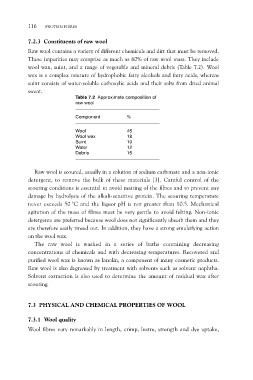
wool wax, suint, and a range of vegetable and mineral debris (Table 7.2). Wool

wax is a complex mixture of hydrophobic fatty alcohols and fatty acids, whereas

suint consists of water-soluble carboxylic acids and their salts from dried animal

sweat.

        Table 7.2 Approximate composition of
        raw wool

        Component               %

        Wool                    45
        Wool wax                18
        Suint                   10
        Water                   12
        Debris                  15

   Raw wool is scoured, usually in a solution of sodium carbonate and a non-ionic
detergent, to remove the bulk of these materials [3]. Careful control of the
scouring conditions is essential to avoid matting of the fibres and to prevent any
damage by hydrolysis of the alkali-sensitive protein. The scouring temperature
never exceeds 50 °C and the liquor pH is not greater than 10.5. Mechanical
agitation of the mass of fibres must be very gentle to avoid felting. Non-ionic
detergents are preferred because wool does not significantly absorb them and they
are therefore easily rinsed out. In addition, they have a strong emulsifying action
on the wool wax.

   The raw wool is washed in a series of baths containing decreasing
concentrations of chemicals and with decreasing temperatures. Recovered and
purified wool wax is known as lanolin, a component of many cosmetic products.
Raw wool is also degreased by treatment with solvents such as solvent naphtha.
Solvent extraction is also used to determine the amount of residual wax after
scouring.

7.3 PHYSICAL AND CHEMICAL PROPERTIES OF WOOL

7.3.1 Wool quality
Wool fibres vary remarkably in length, crimp, lustre, strength and dye uptake,

