


Page 192 - Basic Principles of Textile Coloration
P. 192
Exhaustion/%                                  TERMS USED IN DIRECT EXHAUST DYEING 181

            100
                                                                            Equilibrium?

             50 Decreasing rate

                                                 Initial rate of dyeing    80

                      0
                        0 40
                                                                 Time/min

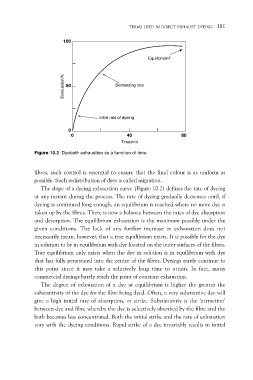
Figure 10.2 Dyebath exhaustion as a function of time

fibres, such control is essential to ensure that the final colour is as uniform as
possible. Such redistribution of dyes is called migration.

   The slope of a dyeing exhaustion curve (Figure 10.2) defines the rate of dyeing
at any instant during the process. The rate of dyeing gradually decreases until, if
dyeing is continued long enough, an equilibrium is reached where no more dye is
taken up by the fibres. There is now a balance between the rates of dye absorption
and desorption. The equilibrium exhaustion is the maximum possible under the
given conditions. The lack of any further increase in exhaustion does not
necessarily mean, however, that a true equilibrium exists. It is possible for the dye
in solution to be in equilibrium with dye located on the outer surfaces of the fibres.
True equilibrium only exists when the dye in solution is in equilibrium with dye
that has fully penetrated into the centre of the fibres. Dyeings rarely continue to
this point since it may take a relatively long time to attain. In fact, many
commercial dyeings barely reach the point of constant exhaustion.

   The degree of exhaustion of a dye at equilibrium is higher the greater the
substantivity of the dye for the fibre being dyed. Often, a very substantive dye will
give a high initial rate of absorption, or strike. Substantivity is the ‘attraction’
between dye and fibre whereby the dye is selectively absorbed by the fibre and the
bath becomes less concentrated. Both the initial strike and the rate of exhaustion
vary with the dyeing conditions. Rapid strike of a dye invariably results in initial

