


Page 196 - Basic Principles of Textile Coloration
P. 196
TERMS USED IN DIRECT EXHAUST DYEING 185
The rate of dyeing depends, in some cases, on the rate of liquor circulation in
the dyeing machine. Dyeing consists of three steps:
(1) transfer of dye from the bulk of the solution to the fibre surface;
(2) adsorption of dye onto the fibre surface;
(3) diffusion of adsorbed dye into the fibre interior.
The adsorption equilibrium is usually rapid, and the overall rate of dyeing depends
on the rate of diffusion of the dye into the fibres. This implies that the rate at
which dye liquor arrives at the surface of the fibres does not control the dyeing
rate. This may not always be so in machines where there is inadequate relative
movement of the goods and dye liquor, or in situations where diffusion is rapid or
the bath concentration is low.
Materials composed of finer fibres have a much larger specific surface (m2 k g–1)
and a higher dyeing rate, even though the equilibrium exhaustion may not be
significantly different from that of a material made of courser fibres of the same
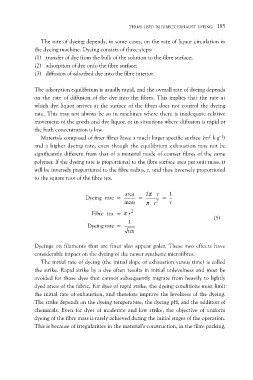
polymer. If the dyeing rate is proportional to the fibre surface area per unit mass, it
will be inversely proportional to the fibre radius, r, and thus inversely proportional
to the square root of the fibre tex.
Dyeing rate area 2p r 1
mass p r2 r
Fibre tex p r2 (5)
Dyeing rate 1
tex
Dyeings on filaments that are finer also appear paler. These two effects have
considerable impact on the dyeing of the newer synthetic microfibres.
The initial rate of dyeing (the initial slope of exhaustion versus time) is called
the strike. Rapid strike by a dye often results in initial unlevelness and must be
avoided for those dyes that cannot subsequently migrate from heavily to lightly
dyed areas of the fabric. For dyes of rapid strike, the dyeing conditions must limit
the initial rate of exhaustion, and therefore improve the levelness of the dyeing.
The strike depends on the dyeing temperature, the dyeing pH, and the addition of
chemicals. Even for dyes of moderate and low strike, the objective of uniform
dyeing of the fibre mass is rarely achieved during the initial stages of the operation.
This is because of irregularities in the material’s construction, in the fibre packing,

