


Page 193 - Basic Principles of Textile Coloration
P. 193
182 AN INTRODUCTION TO DYES AND DYEING

unlevelness of the colour and must be controlled if the dye cannot subsequently
migrate from strongly to weakly dyed areas.

   The dyer must consider the initial strike, the overall rate of dyeing and the
depth of colour that can be obtained in a given dyeing time, even if equilibrium
has not been reached. In order that dyes are economically used, and as little as
possible is wasted in the dyehouse effluent, the dyer prefers a high degree of
exhaustion in a relatively short dyeing time. Dyeing, however, must not be so rapid
that it is difficult to produce a level dyeing.

                         100 100

Temperature/oC  80 3                             80                        Exhaustion (a) or (b) fixation/%
                                   2  4 60

                               2 (c)             40
                             2
                60 2

                 1 (a) (b)
                40

                20 20

                0                                                       0
                  0 20 40 60 80 100                               120
                                                 Time/min

                  1 Add dyes
                  2 Four equal additions of NaCl, total 50 g l–1
                  3 Soda ash, 20 g l–1
                  4 Rinse

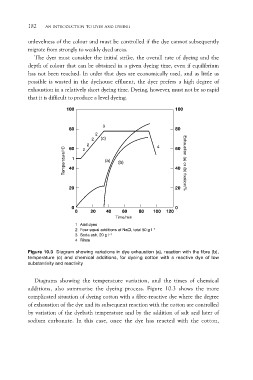
Figure 10.3 Diagram showing variations in dye exhaustion (a), reaction with the fibre (b),
temperature (c) and chemical additions, for dyeing cotton with a reactive dye of low
substantivity and reactivity

   Diagrams showing the temperature variation, and the times of chemical
additions, also summarise the dyeing process. Figure 10.3 shows the more
complicated situation of dyeing cotton with a fibre-reactive dye where the degree
of exhaustion of the dye and its subsequent reaction with the cotton are controlled
by variation of the dyebath temperature and by the addition of salt and later of
sodium carbonate. In this case, once the dye has reacted with the cotton,

