


Page 195 - Basic Principles of Textile Coloration
P. 195
184 AN INTRODUCTION TO DYES AND DYEING
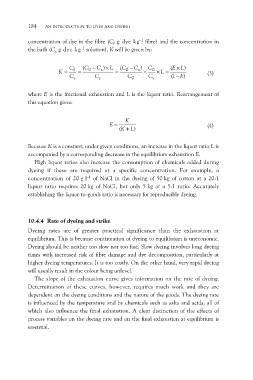
concentration of dye in the fibre (Cf g dye kg–1 fibre) and the concentration in
the bath (Cs g dye kg–1 solution), K will be given by:
K = Cf = (C0 - Cs ) L = (C0 - Cs ) C0 L = (E L) (3)
Cs Cs C0 Cs (1 - E)
where E is the fractional exhaustion and L is the liquor ratio. Rearrangement of
this equation gives:
E= K (4)
(K + L)
Because K is a constant, under given conditions, an increase in the liquor ratio L is
accompanied by a corresponding decrease in the equilibrium exhaustion E.
High liquor ratios also increase the consumption of chemicals added during
dyeing if these are required at a specific concentration. For example, a
concentration of 20 g l–1 of NaCl in the dyeing of 50 kg of cotton at a 20:1
liquor ratio requires 20 kg of NaCl, but only 5 kg at a 5:1 ratio. Accurately
establishing the liquor-to-goods ratio is necessary for reproducible dyeing.
10.4.4 Rate of dyeing and strike
Dyeing rates are of greater practical significance than the exhaustion at
equilibrium. This is because continuation of dyeing to equilibrium is uneconomic.
Dyeing should be neither too slow nor too fast. Slow dyeing involves long dyeing
times with increased risk of fibre damage and dye decomposition, particularly at
higher dyeing temperatures. It is too costly. On the other hand, very rapid dyeing
will usually result in the colour being unlevel.
The slope of the exhaustion curve gives information on the rate of dyeing.
Determination of these curves, however, requires much work and they are
dependent on the dyeing conditions and the nature of the goods. The dyeing rate
is influenced by the temperature and by chemicals such as salts and acids, all of
which also influence the final exhaustion. A clear distinction of the effects of
process variables on the dyeing rate and on the final exhaustion at equilibrium is
essential.

