


Page 191 - Basic Principles of Textile Coloration
P. 191
180 AN INTRODUCTION TO DYES AND DYEING
limited solubility. The concentrated dye stock solution is added to the bath
through a fine sieve to ensure removal of any undissolved particles. The same
techniques are also used to prepare dispersions of insoluble dyes such as vat and
disperse dyes. The particles of such dyes are so fine that they pass through a sieve
as they are added to the dyebath. In some cases, very soluble dyes may be placed
directly into the water already in the dyebath before the goods are present. The
water is then heated by steam injection and more cold water added. Most dyes are
usually easy to dissolve, but the less soluble types require care.
The usual sequence of steps before batch dyeing is to fill the machine with
water, enter the fabric and ensure it is thoroughly wetted. Any initially needed
chemicals are then added. Once the initial dyeing temperature is established, the
dyes are added, either all at once, in several portions, or continuously from a
reservoir, depending on the particular dyeing machine.
10.4 TERMS USED IN DIRECT EXHAUST DYEING
10.4.1 Exhaustion
In exhaust dyeing, all the material contacts all the dye liquor and the fibres absorb
the dyes. The dye concentration in the bath therefore gradually decreases. The
degree of dyebath exhaustion as a function of time describes the rate and extent of
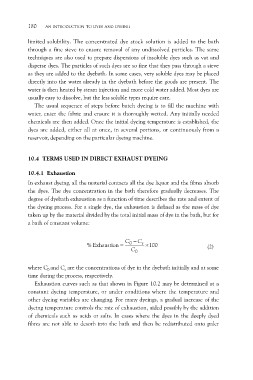
the dyeing process. For a single dye, the exhaustion is defined as the mass of dye
taken up by the material divided by the total initial mass of dye in the bath, but for
a bath of constant volume:
% Exhaustion = C0 - Cs 100 (2)
C0
where C0 and Cs are the concentrations of dye in the dyebath initially and at some
time during the process, respectively.
Exhaustion curves such as that shown in Figure 10.2 may be determined at a
constant dyeing temperature, or under conditions where the temperature and
other dyeing variables are changing. For many dyeings, a gradual increase of the
dyeing temperature controls the rate of exhaustion, aided possibly by the addition
of chemicals such as acids or salts. In cases where the dyes in the deeply dyed
fibres are not able to desorb into the bath and then be redistributed onto paler

