


Page 198 - Basic Principles of Textile Coloration
P. 198
TERMS USED IN DIRECT EXHAUST DYEING 187

dyed fibres during migration usually means that the dyeings have lower fastness to
washing. Dyes of very high washing fastness are essentially non-migrating dyes for
which level dyeing depends upon very careful control of the rate of dye uptake by
the material. The second problem with migrating dyes is that good migration may
result in lower exhaustion, again because of their ability to desorb from the fibres.

   Migration tests characterise a dye’s levelling behaviour. Undyed fabric is treated
with an identical dyed sample in a blank dyebath, with all the required dyeing
chemicals but no added dye, under the same conditions as in dyeing. After a given
time, the degree of transfer of colour from the original dyed to the undyed sample
is evaluated. Alternatively, small samples of the originally undyed and dyed fabric
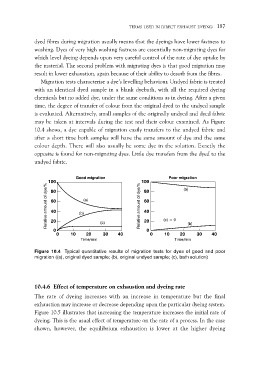
may be taken at intervals during the test and their colour examined. As Figure
10.4 shows, a dye capable of migration easily transfers to the undyed fabric and
after a short time both samples will have the same amount of dye and the same
colour depth. There will also usually be some dye in the solution. Exactly the
opposite is found for non-migrating dyes. Little dye transfers from the dyed to the
undyed fabric.

100     Good migration                                                                          100     Poor migration
 80                                                                                              80                (a)
Relative amount of dye/%60                                                                       60
                                                                      Relative amount of dye/%40(a)40
 20                                                                                              20
   0          (b)                                                                                  0    (c) = 0
     0                        (c)                                                                    0
                                                                                                                 (b)
        10 20 30
               Time/min            40                                                                   10 20 30         40
                                                                                                               Time/min

Figure 10.4 Typical quantitative results of migration tests for dyes of good and poor
migration ((a), original dyed sample; (b), original undyed sample; (c), bath solution)

10.4.6 Effect of temperature on exhaustion and dyeing rate

The rate of dyeing increases with an increase in temperature but the final
exhaustion may increase or decrease depending upon the particular dyeing system.
Figure 10.5 illustrates that increasing the temperature increases the initial rate of
dyeing. This is the usual effect of temperature on the rate of a process. In the case
shown, however, the equilibrium exhaustion is lower at the higher dyeing

