


Page 210 - Basic Principles of Textile Coloration
P. 210
Concentration of dye on fibre (Cf)/g 100 g –1                                                                   DYEING EQUILIBRIA 199

                                               2.0
                                                                                                                                        Saturation

                                               1.5

                                               1.0

                                                                                      Key:

                                               0.5                                          Adsorption, 80:1 liquor
                                                                                            Adsorption, 800:1 liquor

                                                                                            Desorption, 80:1 liquor

                                               0.0             30 60                                                  90
                                                   0  Concentration of dye in residual bath (Cs )/mg l–1

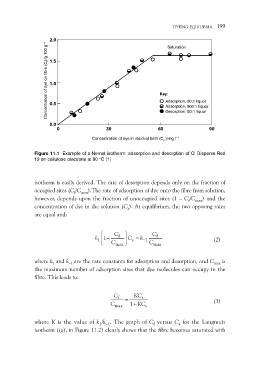
Figure 11.1 Example of a Nernst isotherm: adsorption and desorption of CI Disperse Red
19 on cellulose diacetate at 80 °C [1]

isotherm is easily derived. The rate of desorption depends only on the fraction of

occupied sites (Cf/Cmax).The rate of adsorption of dye onto the fibre from solution,
however, depends upon the fraction of unoccupied sites (1 – Cf/Cmax) and the
concentration of dye in the solution (Cs). At equilibrium, the two opposing rates
are equal and:

                                                        Ë        Cf   Û   Cs  =  k-1   Cf                             (2)
                                                      k1 ÌÍ1 -  Cmax  ÜÝ              Cmax

where k1 and k–1 are the rate constants for adsorption and desorption, and Cmax is
the maximum number of adsorption sites that dye molecules can occupy in the

fibre. This leads to:

                                                                 Cf = KCs                                             (3)
                                                                Cmax 1 + KCs

where K is the value of k1/k–1. The graph of Cf versus Cs for the Langmuir
isotherm ((a), in Figure 11.2) clearly shows that the fibre becomes saturated with

