


Page 213 - Basic Principles of Textile Coloration
P. 213
202 DYEING THEORY

   A transformation, at constant temperature and pressure, occurs so that the
substance transfers from the state of higher to lower chemical potential until
equilibrium is attained. In the case of dyeing, if the chemical potential of the dye
in solution is higher than in the fibre, the dye will transfer to the fibre. The
chemical potential in the solution falls; that in the fibre increases. At equilibrium,
the chemical potential of the dye in the fibre is equal to the chemical potential of
the dye in the solution. These are given by:

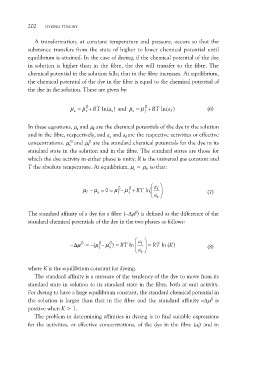
ms  = ms0+ RT ln(as ) and           ms    =  m  0   +  RT  ln(af )  (6)
                                                f

In these equations, ms and mf are the chemical potentials of the dye in the solution
and in the fibre, respectively, and as and af are the respective activities or effective
concentrations. ms0 and mf0 are the standard chemical potentials for the dye in its
standard state in the solution and in the fibre. The standard states are those for

which the dye activity in either phase is unity. R is the universal gas constant and

T the absolute temperature. At equilibrium, ms = mf, so that:

    mf     -  ms  =  0  =  mf0-  m  0  +  RT      Ë    af  Û        (7)
                                    s           ln ÌÍ  as  ÜÝ

The standard affinity of a dye for a fibre (–Dm0) is defined as the difference of the
standard chemical potentials of the dye in the two phases as follows:

- Dm 0  =  -(mf0- ms0)     =  RT    ln  Ë   af  Û   =  RT  ln (K)   (8)
                                        ÌÍ  as  ÜÝ

where K is the equilibrium constant for dyeing.
   The standard affinity is a measure of the tendency of the dye to move from its

standard state in solution to its standard state in the fibre, both at unit activity.
For dyeing to have a large equilibrium constant, the standard chemical potential in
the solution is larger than that in the fibre and the standard affinity –Dm0 is
positive when K > 1.

   The problem in determining affinities in dyeing is to find suitable expressions
for the activities, or effective concentrations, of the dye in the fibre (af) and in

