


Page 253 - Basic Principles of Textile Coloration
P. 253
242 ACID, PRE-METALLISED AND MORDANT DYES

often have only poor light fastness. Sulphonated copper phthalocyanine dyes
provide bright turquoise dyes of very good light fastness.

13.2.2 Classification according to dyeing characteristics

Acid dyes are commonly classified according to their dyeing behaviour, especially
in relation to the dyeing pH, their migration ability during dyeing and their
washing fastness. The molecular weight and the degree of sulphonation of the dye
molecule determine these dyeing characteristics. The original classification of this
type, based on their behaviour in wool dyeing, is as follows:
(1) level dyeing or equalising acid dyes;
(2) fast acid dyes;
(3) milling acid dyes;
(4) super-milling acid dyes.

Milling is the process in which a woollen material is treated, in weakly alkaline
solution, with considerable mechanical action to promote felting. Dyes of good
fastness to milling are essential to avoid colour bleeding during the process.

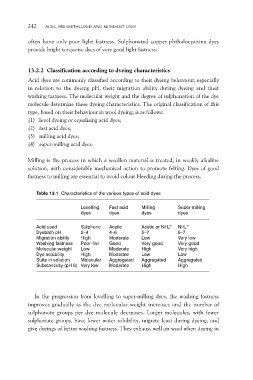
Table 13.1 Characteristics of the various types of acid dyes

                Levelling      Fast acid   Milling            Super-milling
                dyes           dyes        dyes               dyes

Acid used       Sulphuric      Acetic      Acetic or NH4+     NH4+
                               4–6         5–7                6–7
Dyebath pH      2–4            Moderate    Low                Very low
                               Good        Very good          Very good
Migration ability High         Moderate    High               Very high
                               Moderate    Low                Low
Washing fastness Poor–fair     Aggregated  Aggregated         Aggregated
                               Moderate    High               High
Molecular weight Low

Dye solubility  High

State in solution Molecular

Substantivity (pH 6) Very low

   In the progression from levelling to super-milling dyes, the washing fastness
improves gradually as the dye molecular weight increases and the number of
sulphonate groups per dye molecule decreases. Larger molecules, with fewer
sulphonate groups, have lower water solubility, migrate least during dyeing, and
give dyeings of better washing fastness. They exhaust well on wool when dyeing in

