


Page 255 - Basic Principles of Textile Coloration
P. 255
244 ACID, PRE-METALLISED AND MORDANT DYES

ammonium ion groups in the wool. The dye molecules are not, however, firmly
bound to these sites. Their good migration at the boil overcomes any initial colour
unlevelness, provided sufficient time is allowed. If the initial dyeing is not quite on
shade, the bath can be cooled somewhat, appropriate dyes added, and dyeing
continued at the boil.

   Because of the ease of migration of levelling acid dyes during dyeing, the
fastness to washing of their dyeings is only from poor to moderate. Their light
fastness, however, ranges from fair to good. These dyes are therefore used for pale
to medium depths on wool fabric and yarn where a high degree of levelness is
essential and good fastness to washing is not critical. In general, they produce
much brighter shades than mordant or metal-complex dyes. Their relatively small
molecular size provides high water solubility and good penetration into the
individual fibres of tightly woven fabrics and high twist yarns. If the dye molecules
do aggregate in solution at the maximum dyeing temperature, the aggregates are
quite small, or there are enough individual molecules present in the solution for
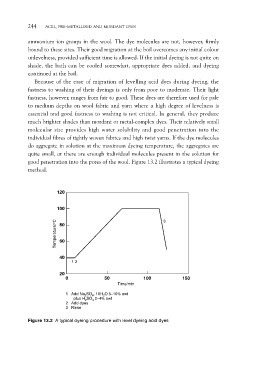
good penetration into the pores of the wool. Figure 13.2 illustrates a typical dyeing
method.

                120

Temperature/oC  100
                                                                                                3

                 80

                60

                40
                         12

                20                   50                       100                                  150
                    0                          Time/min

                     1  Add Na2SO4.  21_04H%2Oow5_f 10%  owf
                         plus H2SO4
                     2 Add dyes

                     3 Rinse

Figure 13.2 A typical dyeing procedure with level dyeing acid dyes

