


Page 256 - Basic Principles of Textile Coloration
P. 256
THE APPLICATION OF ACID DYES IN DYEING WOOL 245

   Wool contains about 820 mmol kg–1 of amino groups, some of which convert
into ammonium ions in the presence of sulphuric acid, with a bound bisulphate
anion. During dyeing, a dye anion displaces the bisulphate ion associated with an
ammonium ion site (Scheme 13.1). In typical dyeings, only a very small fraction of
the available cationic sites have associated dye anions. The wool is far from being
saturated with dye anions. The displacement of simple anions in the wool by dye
anions is a consequence of the dye’s greater substantivity for the wool. Other
possible types of dye–fibre interaction, besides ionic forces, will be discussed later
(Section 13.4.2).

   The added Glauber’s salt acts as a retarding and levelling agent. Sulphate and
bisulphate ions inhibit the initial rapid strike of the dye by occupying and thus
blocking ammonium ion sites in the wool. Dye anions of higher substantivity then
gradually displace the sulphate and bisulphate ions. These anions, however, do
have slight substantivity for the wool and will displace some absorbed dye in acidic
solution. The presence of Glauber’s salt thus promotes levelling and reduces the
dyebath exhaustion. Partial stripping of faulty dyeings is possible using 15–20% owf
of Glauber’s salt in an acidic bath at the boil. Level dyeing can also be controlled
by using less sulphuric or formic acid in the initial bath. This gives fewer cationic
sites in the wool. As dyeing proceeds, more acid is then gradually added to
decrease the bath pH.

   Levelling dyes give decreasing exhaustion on increasing the dyebath pH to
values above 4, and with increasing temperature. These effects are consistent with
a simple ion exchange process that is exothermic. Above the isoelectric point of
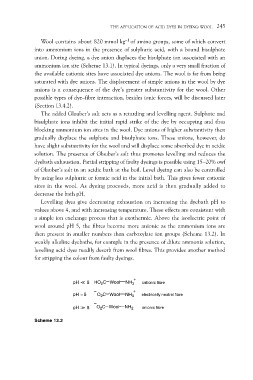
wool around pH 5, the fibres become more anionic as the ammonium ions are
then present in smaller numbers than carboxylate ion groups (Scheme 13.2). In
weakly alkaline dyebaths, for example in the presence of dilute ammonia solution,
levelling acid dyes readily desorb from wool fibres. This provides another method
for stripping the colour from faulty dyeings.

             pH << 5 HO2C Wool NH3 cationic fibre

             pH ≈ 5  O2C Wool NH3 electrically neutral fibre

             pH >> 5 O2C Wool NH2 anionic fibre

Scheme 13.2

