


Page 263 - Basic Principles of Textile Coloration
P. 263
252 ACID, PRE-METALLISED AND MORDANT DYES

Wool dyeing starts under conditions of low substantivity, at low temperatures and
at higher pH. After alkaline scouring of undyed wool, the goods should be run in
the dyeing machine in the presence of a buffer or weak acid to ensure complete
and uniform neutralisation of any residual alkali in the wool. A high initial pH
minimises the number of excess ammonium ion groups in the wool and avoids
rapid initial dye adsorption. The rate of dyeing is controlled by slowly increasing
the temperature of the bath, and possibly also by gradually decreasing the bath pH
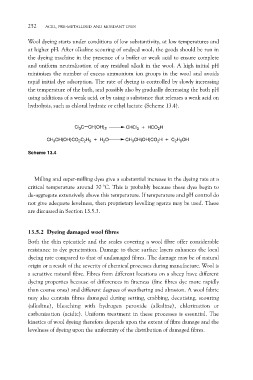
using additions of a weak acid, or by using a substance that releases a weak acid on
hydrolysis, such as chloral hydrate or ethyl lactate (Scheme 13.4).

                              Cl3C CH(OH)2  CHCl3 + HCO2H
            CH3CH(OH)CO2C2H5 + H2O          CH3CH(OH)CO2H + C2H5OH
Scheme 13.4

   Milling and super-milling dyes give a substantial increase in the dyeing rate at a
critical temperature around 70 °C. This is probably because these dyes begin to
de-aggregate extensively above this temperature. If temperature and pH control do
not give adequate levelness, then proprietary levelling agents may be used. These
are discussed in Section 13.5.3.

13.5.2 Dyeing damaged wool fibres

Both the thin epicuticle and the scales covering a wool fibre offer considerable
resistance to dye penetration. Damage to these surface layers enhances the local
dyeing rate compared to that of undamaged fibres. The damage may be of natural
origin or a result of the severity of chemical processes during manufacture. Wool is
a sensitive natural fibre. Fibres from different locations on a sheep have different
dyeing properties because of differences in fineness (fine fibres dye more rapidly
than course ones) and different degrees of weathering and abrasion. A wool fabric
may also contain fibres damaged during setting, crabbing, decatising, scouring
(alkaline), bleaching with hydrogen peroxide (alkaline), chlorination or
carbonisation (acidic). Uniform treatment in these processes is essential. The
kinetics of wool dyeing therefore depends upon the extent of fibre damage and the
levelness of dyeing upon the uniformity of the distribution of damaged fibres.

