


Page 266 - Basic Principles of Textile Coloration
P. 266
Dye + Aux               SPECIAL WOOL DYEING PROCESSES 255

                                Dye Aux

Scheme 13.5

            (CH2CH2O)nCH2CH2OH              (CH2CH2O)nCH2CH2OH
C18H37N H                       C18H37N H

            (CH2CH2O)nCH2CH2OH              (CH2CH2O)nCH2CH2OSO3

                1                               2

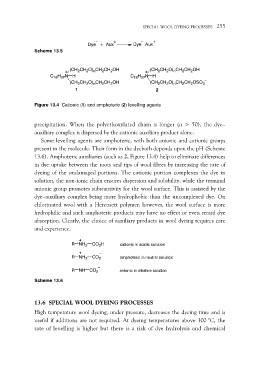
Figure 13.4 Cationic (1) and amphoteric (2) levelling agents

precipitation. When the polyethoxylated chain is longer (n > 50), the dye–
auxiliary complex is dispersed by the cationic auxiliary product alone.

   Some levelling agents are amphoteric, with both anionic and cationic groups
present in the molecule. Their form in the dyebath depends upon the pH (Scheme
13.6). Amphoteric auxiliaries (such as 2, Figure 13.4) help to eliminate differences
in dye uptake between the roots and tips of wool fibres by increasing the rate of
dyeing of the undamaged portions. The cationic portion complexes the dye in
solution, the non-ionic chain ensures dispersion and solubility, while the terminal
anionic group promotes substantivity for the wool surface. This is assisted by the
dye–auxiliary complex being more hydrophobic than the uncomplexed dye. On
chlorinated wool with a Hercosett polymer, however, the wool surface is more
hydrophilic and such amphoteric products may have no effect or even retard dye
absorption. Clearly, the choice of auxiliary products in wool dyeing requires care
and experience.

             R NH2 CO2H         cationic in acidic solution
                                amphoteric in neutral solution
             R NH2 CO2          anionic in alkaline solution

             R NH CO2

Scheme 13.6

13.6 SPECIAL WOOL DYEING PROCESSES

High temperature wool dyeing, under pressure, decreases the dyeing time and is
useful if additions are not required. At dyeing temperatures above 100 °C, the
rate of levelling is higher but there is a risk of dye hydrolysis and chemical

