


Page 268 - Basic Principles of Textile Coloration
P. 268
MORDANT DYES FOR WOOL 257

13.7 MORDANT DYES FOR WOOL

13.7.1 Introduction
In Chapter 1, we saw how metallic mordants improve the fixation and fastness
properties of dyes lacking substantivity for natural fibres. Many of the natural dyes
were polygenetic. They gave different colours with different metallic mordants
such as salts of aluminium, tin, iron or copper. Today, almost all wool mordant
dyes have a chromic ion mordant (Cr3+) and are therefore often called chrome
dyes. The chromic ion is invariably complexed with the dye after the initial dyeing
with an acid dye, to produce dark, dull shades of excellent light and wet fastness.
The final hue is usually quite different from that of the original non-metallised dye
so that colour matching is more difficult than in direct dyeing. The presence of
chromium in the dyehouse effluent poses a severe environmental problem, because
of its toxicity, particularly in the form of dichromate ion (Cr2O72–). Improved
mordanting processes must minimise loss of this metal in the dyehouse effluent.

13.7.2 Basic principles of metal-complex formation

Transition metal ions in aqueous solution can interact with anions to form simple
salts such as FeCl3, which results from a combination of one Fe3+ and three Cl–
ions. They also combine with anions and neutral electron donors to form
complexes involving coordinate covalent bonds. For example, potassium
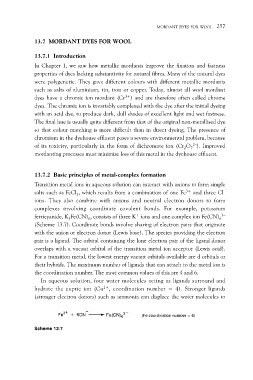
ferricyanide, K3Fe(CN)6, consists of three K+ ions and one complex ion Fe(CN)63–
(Scheme 13.7). Coordinate bonds involve sharing of electron pairs that originate
with the anion or electron donor (Lewis base). The species providing the electron
pair is a ligand. The orbital containing the lone electron pair of the ligand donor
overlaps with a vacant orbital of the transition metal ion acceptor (Lewis acid).
For a transition metal, the lowest energy vacant orbitals available are d orbitals or
their hybrids. The maximum number of ligands that can attach to the metal ion is
the coordination number. The most common values of this are 4 and 6.

   In aqueous solution, four water molecules acting as ligands surround and
hydrate the cupric ion (Cu2+, coordination number = 4). Stronger ligands
(stronger electron donors) such as ammonia can displace the water molecules to

               Fe3 + 6CN  Fe(CN)63  (Fe coordination number = 6)
Scheme 13.7

