


Page 267 - Basic Principles of Textile Coloration
P. 267
256 ACID, PRE-METALLISED AND MORDANT DYES

reduction of azo dyes by wool degradation products. Addition of a small amount of
a mild oxidising agent prevents such reduction. Dyeing at 110 °C, for not longer
than 60 min, at a pH around 5, avoids damaging the wool fibres. Dyeing at
120 °C is possible for wool/polyester blends but the dyebath must contain fibre-
protective agents. These are often products that slowly release formaldehyde, such
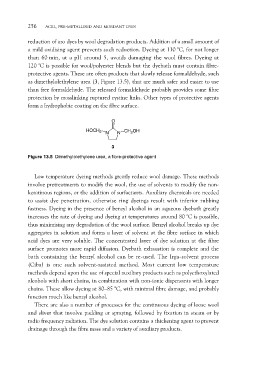
as dimethylolethylene urea (3, Figure 13.5), that are much safer and easier to use
than free formaldehyde. The released formaldehyde probably provides some fibre
protection by crosslinking ruptured cystine links. Other types of protective agents
form a hydrophobic coating on the fibre surface.

                                                       O

                                      HOCH2 N N CH2OH

                                                       3

Figure 13.5 Dimethylolethylene urea, a fibre-protective agent

   Low temperature dyeing methods greatly reduce wool damage. These methods
involve pretreatments to modify the wool, the use of solvents to modify the non-
keratinous regions, or the addition of surfactants. Auxiliary chemicals are needed
to assist dye penetration, otherwise ring dyeings result with inferior rubbing
fastness. Dyeing in the presence of benzyl alcohol in an aqueous dyebath greatly
increases the rate of dyeing and dyeing at temperatures around 80 °C is possible,
thus minimising any degradation of the wool surface. Benzyl alcohol breaks up dye
aggregates in solution and forms a layer of solvent at the fibre surface in which
acid dyes are very soluble. The concentrated layer of dye solution at the fibre
surface promotes more rapid diffusion. Dyebath exhaustion is complete and the
bath containing the benzyl alcohol can be re-used. The Irga-solvent process
(Ciba) is one such solvent-assisted method. Most current low temperature
methods depend upon the use of special auxiliary products such as polyethoxylated
alcohols with short chains, in combination with non-ionic dispersants with longer
chains. These allow dyeing at 80–85 °C, with minimal fibre damage, and probably
function much like benzyl alcohol.

   There are also a number of processes for the continuous dyeing of loose wool
and sliver that involve padding or spraying, followed by fixation in steam or by
radio frequency radiation. The dye solution contains a thickening agent to prevent
drainage through the fibre mass and a variety of auxiliary products.

