


Page 320 - Basic Principles of Textile Coloration
P. 320
CHEMICAL CONSTITUTIONS OF DISPERSE DYES 309

15.2 CHEMICAL CONSTITUTIONS OF DISPERSE DYES

The majority of disperse dyes are low molecular weight, non-ionic mono-azo and
anthraquinone derivatives. Polar substituents are usually present in the dye
molecule so that the dye has the slight solubility in water required for dyeing.
Hydroxyethylamino groups (NHCH2CH2OH) are typical of such substituents. The
interaction of such polar groups with the water, by dipole interactions and
hydrogen bonds, is crucial for water solubility. Dipole forces and hydrogen bonds,
as well as dispersion forces, also bind the dye molecules to polar groups in the
fibres.

   There are many thousands of azo disperse dye structures because of the
numerous substitution patterns possible in the diverse diazonium ion and coupling
components. Colours that are less typical of simple azo compounds, such as
greenish-yellow and blue, are also possible using more specialised components.
These may have heterocyclic units or cyano substituents. There is also a limited
number of other chromophores providing disperse dyes with particular properties.
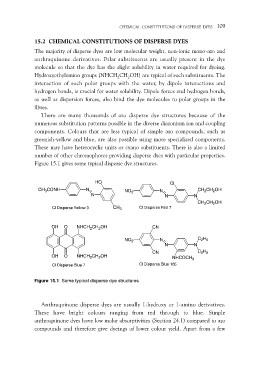
Figure 15.1 gives some typical disperse dye structures.

CH3CONH        HO          NO2                              Cl            CH2CH2OH
                                                                        N
         N                                            N
            N                                            N                CH2CH2OH

CI Disperse Yellow 3  CH3                         CI Disperse Red 7

OH O NHCH2CH2OH                                   CN

OH O NHCH2CH2OH            NO2                        N                   C2H5
CI Disperse Blue 7                                       N              N

                                                  CN C2H5
                                                               NHCOCH3

                                                  CI Disperse Blue 165

Figure 15.1 Some typical disperse dye structures

   Anthraquinone disperse dyes are usually 1-hydroxy or 1-amino derivatives.
These have bright colours ranging from red through to blue. Simple
anthraquinone dyes have low molar absorptivities (Section 24.1) compared to azo
compounds and therefore give dyeings of lower colour yield. Apart from a few

