


Page 319 - Basic Principles of Textile Coloration
P. 319
308 DISPERSE DYES

contained a methylamino sulphonate group (–NHCH2SO3Na) introduced by
reaction of a primary amino group with formaldehyde and sodium bisulphite
(Ionamine dyes, 1922). During dyeing, this group hydrolysed to the less soluble
parent amine (Scheme 15.1). It was soon recognised that it was this compound
that the cellulose acetate absorbed. The first true disperse dyes were simple,
relatively insoluble azo and anthraquinone compounds dispersed in water using
the sodium salt of sulphated ricinoleic acid (1, in Figure 15.2). Many of these dyes
are obsolete but their development provided the technology for preparing fine
aqueous dispersions by grinding the dye with dispersing agents. A fine dispersion is
essential for rapid dyeing and avoids deposition of larger dye particles on the
material.

   Disperse dyes have slight water solubility because of the presence of polar
substituents in their molecular structures. During dyeing, a small quantity of dye is
present in true aqueous solution in a monomolecular form. These dye molecules
are able to penetrate into hydrophobic artificially-made fibres such as those of
cellulose acetate, nylon or polyester. The dye is much more soluble in the fibre
than in water so deep dyeings are possible. The dye particles in dispersion are very
small. Their large specific surface area ensures rapid solution to maintain
saturation of the aqueous solution as the soluble dye transfers to the fibre. Dyeing
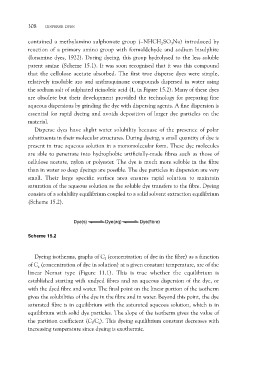
consists of a solubility equilibrium coupled to a solid solvent extraction equilibrium
(Scheme 15.2).

             Dye(s)  Dye(aq)  Dye(fibre)

Scheme 15.2

   Dyeing isotherms, graphs of Cf (concentration of dye in the fibre) as a function
of Cs (concentration of dye in solution) at a given constant temperature, are of the
linear Nernst type (Figure 11.1). This is true whether the equilibrium is
established starting with undyed fibres and an aqueous dispersion of the dye, or
with the dyed fibre and water. The final point on the linear portion of the isotherm
gives the solubilities of the dye in the fibre and in water. Beyond this point, the dye
saturated fibre is in equilibrium with the saturated aqueous solution, which is in
equilibrium with solid dye particles. The slope of the isotherm gives the value of
the partition coefficient (Cf/Cs). This dyeing equilibrium constant decreases with
increasing temperature since dyeing is exothermic.

