


Page 375 - Basic Principles of Textile Coloration
P. 375
364 VAT DYES
Anthraquinone vat dyes have large negative standard redox potentials, giving
unfavourable positive values of DG°, and therefore their reduction requires strong
reducing agents. Conversely, the leuco compound in alkaline solution is readily
oxidised. The potentiometric titration of the leuco compound in solution with an
oxidising agent is complicated by the precipitation of the insoluble quinone
pigment, even in the first stages of the titration. This usually results in unstable
potentials and the usual form of the titration curve is not followed. Complete
oxidation of the leuco form can, however, usually be detected and the titration is
useful for analysis of the actual dye content of vat dye samples (Figure 17.3). The
titration is usually performed using potassium ferricyanide solution as oxidising
agent. The reaction involved is:
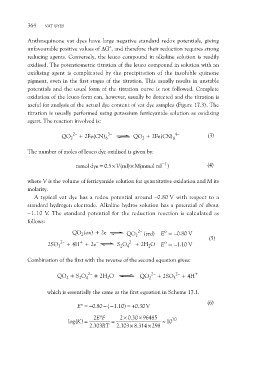
QO22– + 2Fe(CN)63– QO2 + 2Fe(CN)64– (3)
The number of moles of leuco dye oxidised is given by: (4)
mmol dye = 0.5 V(ml) M(mmol ml-1)
where V is the volume of ferricyanide solution for quantitative oxidation and M its
molarity.
A typical vat dye has a redox potential around –0.80 V with respect to a
standard hydrogen electrode. Alkaline hydros solution has a potential of about
–1.10 V. The standard potential for the reduction reaction is calculated as
follows:
QO2(ox) + 2e– QO22– (red) Eo = –0.80 V (5)
2SO32– + 4H+ + 2e– S2O42– + 2H2O Eo = –1.10 V
Combination of the first with the reverse of the second equation gives:
QO2 + S2O42– + 2H2O QO22– + 2SO32– + 4H+
which is essentially the same as the first equation in Scheme 17.1.
E = -0.80 -( -1.10) = +0.30 V (6)
log(K) = 2EF = 2 0.30 96485 1010
2.303RT 2.303 8.314 298

