


Page 377 - Basic Principles of Textile Coloration
P. 377
366 VAT DYES

size but, in general, the rate of reduction is higher for finer particles. The effects of
these physical parameters are far less significant than the differences between dyes
of different structures. Vatting rates are fairly easy to measure since the solution of
the leuco compound usually has a colour quite different from the quinone
pigment. Times of half reduction (the time required to achieve 50% reduction of
the pigment dispersion under given conditions) vary by a factor of over 600.

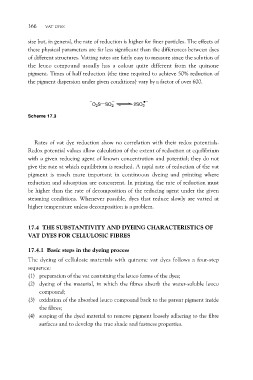
             O2S SO2  2SO2

Scheme 17.3

   Rates of vat dye reduction show no correlation with their redox potentials.
Redox potential values allow calculation of the extent of reduction at equilibrium
with a given reducing agent of known concentration and potential; they do not
give the rate at which equilibrium is reached. A rapid rate of reduction of the vat
pigment is much more important in continuous dyeing and printing where
reduction and adsorption are concurrent. In printing, the rate of reduction must
be higher than the rate of decomposition of the reducing agent under the given
steaming conditions. Whenever possible, dyes that reduce slowly are vatted at
higher temperature unless decomposition is a problem.

17.4 THE SUBSTANTIVITY AND DYEING CHARACTERISTICS OF
VAT DYES FOR CELLULOSIC FIBRES

17.4.1 Basic steps in the dyeing process
The dyeing of cellulosic materials with quinone vat dyes follows a four-step
sequence:
(1) preparation of the vat containing the leuco forms of the dyes;
(2) dyeing of the material, in which the fibres absorb the water-soluble leuco

     compound;
(3) oxidation of the absorbed leuco compound back to the parent pigment inside

     the fibres;
(4) soaping of the dyed material to remove pigment loosely adhering to the fibre

     surfaces and to develop the true shade and fastness properties.

