


Page 404 - Basic Principles of Textile Coloration
P. 404
DYEING ACRYLIC FIBRES WITH CATIONIC DYES 393

                100

                     0.5 oC min–1  Slow

Temperature/oC  80                 cooling

                          60                                                200
                                             1.5 oC min–1

                          40

                              0 50 100 150
                                                                  Time/min

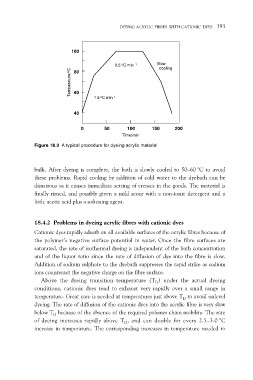
Figure 18.3 A typical procedure for dyeing acrylic material

bulk. After dyeing is complete, the bath is slowly cooled to 50–60 °C to avoid
these problems. Rapid cooling by addition of cold water to the dyebath can be
disastrous as it causes immediate setting of creases in the goods. The material is
finally rinsed, and possibly given a mild scour with a non-ionic detergent and a
little acetic acid plus a softening agent.

18.4.2 Problems in dyeing acrylic fibres with cationic dyes

Cationic dyes rapidly adsorb on all available surfaces of the acrylic fibres because of
the polymer’s negative surface potential in water. Once the fibre surfaces are
saturated, the rate of isothermal dyeing is independent of the bath concentration
and of the liquor ratio since the rate of diffusion of dye into the fibre is slow.
Addition of sodium sulphate to the dyebath suppresses the rapid strike as sodium
ions counteract the negative charge on the fibre surface.

   Above the dyeing transition temperature (TD) under the actual dyeing
conditions, cationic dyes tend to exhaust very rapidly over a small range in
temperature. Great care is needed at temperatures just above TD to avoid unlevel
dyeing. The rate of diffusion of the cationic dyes into the acrylic fibre is very slow
below TD because of the absence of the required polymer chain mobility. The rate
of dyeing increases rapidly above TD, and can double for every 2.5–3.0 °C
increase in temperature. The corresponding increases in temperature needed to

