


Page 407 - Basic Principles of Textile Coloration
P. 407
396 CATIONIC DYES
One standard test (AATCC Test Method 141 [1]) evaluates a dye’s com-
bination constant or compatibility value k, a number from 1 (rapid dyeing) to 5
(slow dyeing). Dyeings of a given cationic dye are carried out in mixtures with
each dye of a standard series of five blue or five yellow dyes. The series selected
will have a yellow or blue hue markedly contrasting with the test dye. Thus, a
violet cationic dye would be tested in mixtures with the series of yellow dyes rather
than the blue series. The five dyes in each standard series have compatibility
ratings from 1 to 5. At pre-selected times during the dyeing trials with mixtures of
the test and standard dyes, a piece of the dyed material is replaced by undyed
material and dyeing continued. For each mixture of test dye and standard dye, the
colours of the successively dyed samples are examined. The combination constant
(k = 1 to 5) for the test dye is that of the standard dye for which the series of
dyeings are on shade. Compatible dyes should therefore have about the same k
values. This type of information is available from the dye manufacturers.
Fibre saturation values give the number of anionic sites in the fibre
(mmol kg–1). This value ranges from about 25 up to 115 mmol kg–1. The fibre
saturation value determines the % owf of cationic dye or retarder that will saturate
all the anionic sites. These amounts can be calculated if the molecular weight,
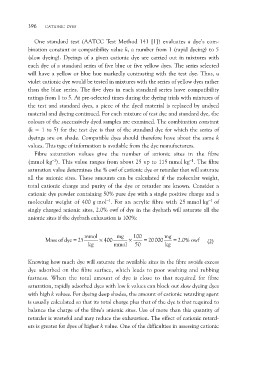
total cationic charge and purity of the dye or retarder are known. Consider a
cationic dye powder containing 50% pure dye with a single positive charge and a
molecular weight of 400 g mol–1. For an acrylic fibre with 25 mmol kg–1 of
singly charged anionic sites, 2.0% owf of dye in the dyebath will saturate all the
anionic sites if the dyebath exhaustion is 100%:
Mass of dye = 25 mmol 400 mg 100 = 20 000 mg = 2.0% owf (2)
kg mmol 50 kg
Knowing how much dye will saturate the available sites in the fibre avoids excess
dye adsorbed on the fibre surface, which leads to poor washing and rubbing
fastness. When the total amount of dye is close to that required for fibre
saturation, rapidly adsorbed dyes with low k values can block out slow dyeing dyes
with high k values. For dyeing deep shades, the amount of cationic retarding agent
is usually calculated so that its total charge plus that of the dye is that required to
balance the charge of the fibre’s anionic sites. Use of more than this quantity of
retarder is wasteful and may reduce the exhaustion. The effect of cationic retard-
ers is greater for dyes of higher k value. One of the difficulties in assessing cationic

