


Page 405 - Basic Principles of Textile Coloration
P. 405
394 CATIONIC DYES
double the dyeing rates of nylon and polyester are typically 10 and 5 °C,
respectively, but at higher temperatures for polyester. Once the acrylic fibre
becomes accessible, very careful temperature control is required. For this reason,
once the bath temperature reaches 70–75 °C, the rate of heating is usually
significantly decreased (Figure 18.3).
The careful temperature control required when dyeing acrylic fibres with
cationic dyes is necessary to avoid unlevel dyeings. These dyes on acrylic materials
have at best poor migration ability. Some newer types of more hydrophilic cationic
dyes have low molecular weights and lower substantivity. They migrate more
readily but attempted levelling by extended heating, or heating to a higher dyeing
temperature, is dangerous because of the thermoplasticity of the fibre.
If the acrylic fibre has a significant number of carboxylate groups present, the
dyeing pH will greatly influence the dyeing rate. The rate of exhaustion will
increase with increase in the pH as more carboxylic acid groups dissociate. Thus, it
is important to know the characteristics of the particular acrylic polymer in
advance.
18.4.3 Dyeing mechanism
Although a simple ion exchange mechanism explains many effects in the dyeing of
acrylic fibres, the process is probably more complex than this. Over-dyeing is not
usually a problem as the fibres rarely accept more dye than corresponds to the
number of anionic sites. The sulphonate and sulphate groups do not change with
variation of the dyebath pH but this is not true for carboxylate groups. In acidic
solution, carboxylate groups are protonated and their negative charge neutralised.
For dyeings carried out at constant pH, the Langmuir isotherm provides a good
description of the dyeing equilibrium (Section 11.1.1). The number of anionic
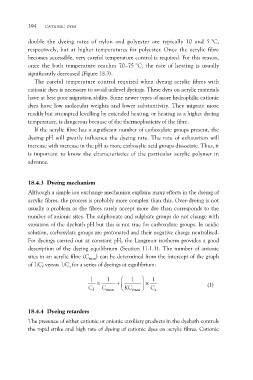
sites in an acrylic fibre (Cmax) can be determined from the intercept of the graph
of 1/Cf versus 1/Cs for a series of dyeings at equilibrium:
1 = 1 + Ë 1 Û 1 (1)
Cf Cmax ÍÌ KCmax ÝÜ Cs
18.4.4 Dyeing retarders
The presence of either cationic or anionic auxiliary products in the dyebath controls
the rapid strike and high rate of dyeing of cationic dyes on acrylic fibres. Cationic

