


Page 415 - Basic Principles of Textile Coloration
P. 415
404 DYES SYNTHESISED IN THE FIBRE

advantage of diazoamino or diazotate derivatives is that frequently both the
stabilised diazonium component and the coupling component can be padded or
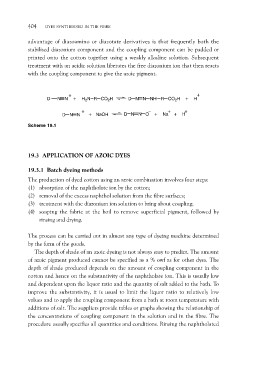
printed onto the cotton together using a weakly alkaline solution. Subsequent
treatment with an acidic solution liberates the free diazonium ion that then reacts
with the coupling component to give the azoic pigment.

             +                                                                   +
D N N + H2N R CO2H                 D N N NH R CO2H + H
                                 D N N O + Na+ + H+
             D  N    +  +  NaOH
                   N

Scheme 19.1

19.3 APPLICATION OF AZOIC DYES

19.3.1 Batch dyeing methods

The production of dyed cotton using an azoic combination involves four steps:
(1) absorption of the naphtholate ion by the cotton;
(2) removal of the excess naphthol solution from the fibre surfaces;
(3) treatment with the diazonium ion solution to bring about coupling;
(4) soaping the fabric at the boil to remove superficial pigment, followed by

      rinsing and drying.

The process can be carried out in almost any type of dyeing machine determined
by the form of the goods.

   The depth of shade of an azoic dyeing is not always easy to predict. The amount
of azoic pigment produced cannot be specified as a % owf as for other dyes. The
depth of shade produced depends on the amount of coupling component in the
cotton and hence on the substantivity of the naphtholate ion. This is usually low
and dependent upon the liquor ratio and the quantity of salt added to the bath. To
improve the substantivity, it is usual to limit the liquor ratio to relatively low
values and to apply the coupling component from a bath at room temperature with
additions of salt. The suppliers provide tables or graphs showing the relationship of
the concentrations of coupling component in the solution and in the fibre. The
procedure usually specifies all quantities and conditions. Rinsing the naphtholated

