


Page 45 - Basic Principles of Textile Coloration
P. 45
34 FIBROUS POLYMERS

CHAPTER 3

Fibrous polymers

This chapter introduces some principles of polymer chemistry and discusses the
structural characteristics of the major fibrous polymers and their important
properties, particularly those related to dyeing. Later chapters will provide more
details on specific fibres.

3.1 POLYMER STRUCTURE
Polymers consist of molecules with very high molecular weights. The word
‘polymer’ comes from the Greek words poly meaning ‘many’, and meros meaning
‘part’. It therefore refers to the many simple structural units, linked in a
continuous chain, that constitute a polymer molecule. These units are often
identical. This repetitive structural pattern in polymers was not clearly recognised
before about 1925, after the development of much of the technology for dyeing
natural and regenerated fibres.

   A monomer is a simple chemical species whose molecules link to produce a
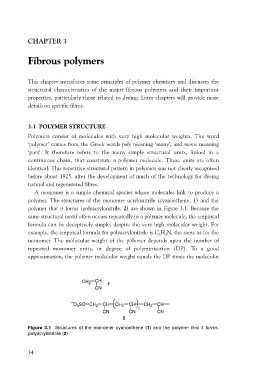
polymer. The structures of the monomer acrylonitrile (cyanoethene, 1) and the
polymer that it forms (polyacrylonitrile, 2) are shown in Figure 3.1. Because the
same structural motif often occurs repeatedly in a polymer molecule, the empirical
formula can be deceptively simple, despite the very high molecular weight. For
example, the empirical formula for polyacrylonitrile is C3H3N, the same as for the
monomer. The molecular weight of the polymer depends upon the number of
repeated monomer units, or degree of polymerisation (DP). To a good
approximation, the polymer molecular weight equals the DP times the molecular

    CH2 CH 1
            CN

    _                       CH2  CH         CH2  CH
     O3SO CH2 CH                                 CN
                                         n
                        CN       CN

                            2

Figure 3.1 Structures of the monomer cyanoethene (1) and the polymer that it forms,
polyacrylonitrile (2)

34

