


Page 47 - Basic Principles of Textile Coloration
P. 47
36 FIBROUS POLYMERS

reactive sites are now ionic and the polymerisation is terminated by addition of
appropriate chemicals.

   Such chain reactions are usually very fast and the product isolated from an
interrupted process consists of only residual monomer and fully formed polymer of
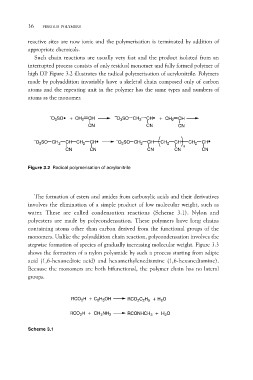
high DP. Figure 3.2 illustrates the radical polymerisation of acrylonitrile. Polymers
made by polyaddition invariably have a skeletal chain composed only of carbon
atoms and the repeating unit in the polymer has the same types and numbers of
atoms as the monomer.

_           + CH2 CH        _                       + CH2 CH
O3SO                    CN   O3SO CH2 CH                        CN

                                                CN

_                           _                       CH2 CH CH2 CH
 O3SO CH2 CH CH2 CH          O3SO CH2 CH
                                                                        n
                     CN CN                      CN
                                                             CN CN

Figure 3.2 Radical polymerisation of acrylonitrile

   The formation of esters and amides from carboxylic acids and their derivatives
involves the elimination of a simple product of low molecular weight, such as
water. These are called condensation reactions (Scheme 3.1). Nylon and
polyesters are made by polycondensation. These polymers have long chains
containing atoms other than carbon derived from the functional groups of the
monomers. Unlike the polyaddition chain reaction, polycondensation involves the
stepwise formation of species of gradually increasing molecular weight. Figure 3.3
shows the formation of a nylon polyamide by such a process starting from adipic
acid (1,6-hexanedioic acid) and hexamethylenediamine (1,6-hexanediamine).
Because the monomers are both bifunctional, the polymer chain has no lateral
groups.

            RCO2H + C2H5OH  RCO2C2H5 + H2O
            RCO2H + CH3NH2  RCONHCH3 + H2O

Scheme 3.1

