


Page 50 - Basic Principles of Textile Coloration
P. 50
POLYMER STRUCTURE 39

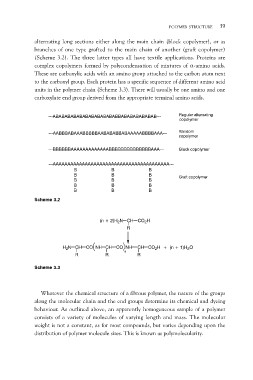
alternating long sections either along the main chain (block copolymer), or as
branches of one type grafted to the main chain of another (graft copolymer)
(Scheme 3.2). The three latter types all have textile applications. Proteins are
complex copolymers formed by polycondensation of mixtures of a-amino acids.
These are carboxylic acids with an amino group attached to the carbon atom next
to the carboxyl group. Each protein has a specific sequence of different amino acid
units in the polymer chain (Scheme 3.3). There will usually be one amino and one
carboxylate end group derived from the appropriate terminal amino acids.

---ABABABABABABABABABABABBABABABABABAB---       Regular alternating
---AABBBABAAABBBBBAABABABBABAAAAABBBBAAA---     copolymer
---BBBBBBAAAAAAAAAAAAABBBBBBBBBBBBBBAAA---
                                                Random
                                                copolymer

                                                Block copolymer

---AAAAAAAAAAAAAAAAAAAAAAAAAAAAAAAAAAAAAAAA---  Graft copolymer

                BBB
                BBB
                BBB
                BBB
                BBB

Scheme 3.2

            (n + 2)H2N CH CO2H
                              R

            H2N CH CO NH CH CO NH CH CO2H + (n + 1)H2O
                n
            RR     R

Scheme 3.3

   Whatever the chemical structure of a fibrous polymer, the nature of the groups
along the molecular chain and the end groups determine its chemical and dyeing
behaviour. As outlined above, an apparently homogeneous sample of a polymer
consists of a variety of molecules of varying length and mass. The molecular
weight is not a constant, as for most compounds, but varies depending upon the
distribution of polymer molecule sizes. This is known as polymolecularity.

