


Page 57 - Basic Principles of Textile Coloration
P. 57
46 FIBROUS POLYMERS

iron can melt cellulose diacetate and produce a hole in a fabric made from it. To
avoid creasing and over-extension of the fabric, cellulose diacetate materials must
be dyed at no higher than 85–90 °C, in open width, and with a minimum of
tension. High-bulk texturised acrylic fibres usually give fabrics with good crease
resistance. Such materials are, however, quite plastic when hot and excessive
tension must be avoided during dyeing. Rapid cooling of the goods by flooding a
hot dyebath with cold water causes a sudden change from plastic to rigid
behaviour and will set creases in the fabric. Slow cooling of the bath and gentle
motion of the material are essential.

   For thermoplastic materials, the glass transition temperature (Tg) is that at
which molecules in the solid, glassy state, characteristic of the amorphous zones of
the polymer, have sufficient energy for entire segments of the polymer chains to
become mobile. At temperatures below Tg, the molecules are frozen in position
and the polymer is rigid. Above this temperature, the available thermal energy is
sufficient to cause bond rotations allowing segments of the polymer chain to move
into new positions. This results in significant changes in the physical properties of
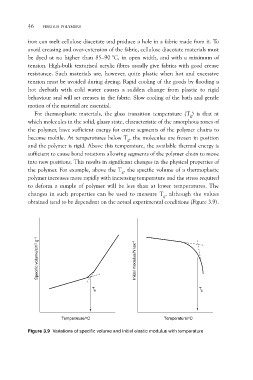
the polymer. For example, above the Tg, the specific volume of a thermoplastic
polymer increases more rapidly with increasing temperature and the stress required
to deform a sample of polymer will be less than at lower temperatures. The
changes in such properties can be used to measure Tg, although the values
obtained tend to be dependent on the actual experimental conditions (Figure 3.9).

Specific volume/cm3 g–1
                                                                          Initial modulus/N tex–1

                Tg Tg

Temperature/oC                                                                                     Temperature/oC

Figure 3.9 Variations of specific volume and initial elastic modulus with temperature

