


Page 56 - Basic Principles of Textile Coloration
P. 56
THERMAL PROPERTIES OF POLYMERS 45

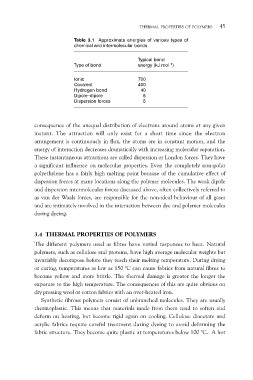
Table 3.1 Approximate energies of various types of
chemical and intermolecular bonds

Type of bond       Typical bond
                   energy (kJ mol–1)

Ionic              700
Covalent           400
Hydrogen bond
Dipole–dipole       40
Dispersion forces     5
                      5

consequence of the unequal distribution of electrons around atoms at any given
instant. The attraction will only exist for a short time since the electron
arrangement is continuously in flux, the atoms are in constant motion, and the
energy of interaction decreases dramatically with increasing molecular separation.
These instantaneous attractions are called dispersion or London forces. They have
a significant influence on molecular properties. Even the completely non-polar
polyethylene has a fairly high melting point because of the cumulative effect of
dispersion forces at many locations along the polymer molecules. The weak dipole
and dispersion intermolecular forces discussed above, often collectively referred to
as van der Waals forces, are responsible for the non-ideal behaviour of all gases
and are intimately involved in the interaction between dye and polymer molecules
during dyeing.

3.4 THERMAL PROPERTIES OF POLYMERS

The different polymers used as fibres have varied responses to heat. Natural
polymers, such as cellulose and proteins, have high average molecular weights but
invariably decompose before they reach their melting temperature. During drying
or curing, temperatures as low as 150 °C can cause fabrics from natural fibres to
become yellow and more brittle. The thermal damage is greater the longer the
exposure to the high temperature. The consequences of this are quite obvious on
dry pressing wool or cotton fabrics with an over-heated iron.

   Synthetic fibrous polymers consist of unbranched molecules. They are usually
thermoplastic. This means that materials made from them tend to soften and
deform on heating, but become rigid again on cooling. Cellulose diacetate and
acrylic fabrics require careful treatment during dyeing to avoid deforming the
fabric structure. They become quite plastic at temperatures below 100 °C. A hot

