


Page 52 - Basic Principles of Textile Coloration
P. 52
MOLECULAR ORGANISATION IN FIBRES 41

diffraction thus identifies the atoms and their relative positions. It is a powerful
method for determining the structures of molecules.

   Diffraction of an X-ray beam impinging on an extended fibre at right angles to
its axis often gives a pattern of dots characteristic of a crystal, but accompanied by
the more diffuse pattern characteristic of amorphous materials. Many fibres are
partly crystalline in regions where chain orientation is high and the closely spaced
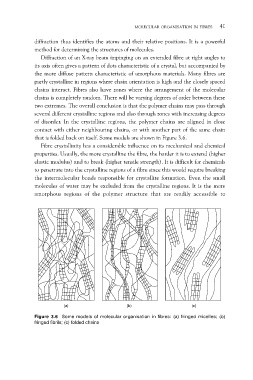
chains interact. Fibres also have zones where the arrangement of the molecular
chains is completely random. There will be varying degrees of order between these
two extremes. The overall conclusion is that the polymer chains may pass through
several different crystalline regions and also through zones with increasing degrees
of disorder. In the crystalline regions, the polymer chains are aligned in close
contact with either neighbouring chains, or with another part of the same chain
that is folded back on itself. Some models are shown in Figure 3.6.

   Fibre crystallinity has a considerable influence on its mechanical and chemical
properties. Usually, the more crystalline the fibre, the harder it is to extend (higher
elastic modulus) and to break (higher tensile strength). It is difficult for chemicals
to penetrate into the crystalline regions of a fibre since this would require breaking
the intermolecular bonds responsible for crystallite formation. Even the small
molecules of water may be excluded from the crystalline regions. It is the more
amorphous regions of the polymer structure that are readily accessible to

(a) (b)  (c)

Figure 3.6 Some models of molecular organisation in fibres: (a) fringed micelles; (b)
fringed fibrils; (c) folded chains

