


Page 184 - Elementary_Linear_Algebra_with_Applications_Anton__9_edition
P. 184
3.1                                   In this section, vectors in 2-space and 3-space will be introduced geometrically,
                                      arithmetic operations on vectors will be defined, and some basic properties of
INTRODUCTION TO                       these arithmetic operations will be established.
VECTORS (GEOMETRIC)

Geometric Vectors

Vectors can be represented geometrically as directed line segments or arrows in 2-space or 3-space. The direction of the arrow
specifies the direction of the vector, and the length of the arrow describes its magnitude. The tail of the arrow is called the initial
point of the vector, and the tip of the arrow the terminal point. Symbolically, we shall denote vectors in lowercase boldface type
(for instance, a, k, v, w, and x). When discussing vectors, we shall refer to numbers as scalars. For now, all our scalars will be
real numbers and will be denoted in lowercase italic type (for instance, a, k, v, w, and x).

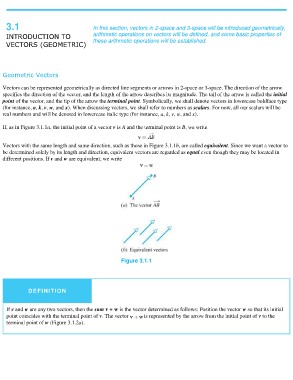
If, as in Figure 3.1.1a, the initial point of a vector v is A and the terminal point is B, we write

Vectors with the same length and same direction, such as those in Figure 3.1.1b, are called equivalent. Since we want a vector to
be determined solely by its length and direction, equivalent vectors are regarded as equal even though they may be located in
different positions. If v and w are equivalent, we write

                                      Figure 3.1.1

DEFINITION

If v and w are any two vectors, then the sum v + w is the vector determined as follows: Position the vector w so that its initial

point coincides with the terminal point of v. The vector  is represented by the arrow from the initial point of v to the

terminal point of w (Figure 3.1.2a).

