


Page 188 - Elementary_Linear_Algebra_with_Applications_Anton__9_edition
P. 188
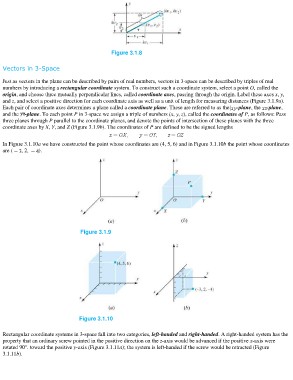
Figure 3.1.8

Vectors in 3-Space

Just as vectors in the plane can be described by pairs of real numbers, vectors in 3-space can be described by triples of real
numbers by introducing a rectangular coordinate system. To construct such a coordinate system, select a point O, called the
origin, and choose three mutually perpendicular lines, called coordinate axes, passing through the origin. Label these axes x, y,
and z, and select a positive direction for each coordinate axis as well as a unit of length for measuring distances (Figure 3.1.9a).
Each pair of coordinate axes determines a plane called a coordinate plane. These are referred to as the -plane, the -plane,
and the -plane. To each point P in 3-space we assign a triple of numbers (x, y, z), called the coordinates of P, as follows: Pass
three planes through P parallel to the coordinate planes, and denote the points of intersection of these planes with the three
coordinate axes by X, Y, and Z (Figure 3.1.9b). The coordinates of P are defined to be the signed lengths
In Figure 3.1.10a we have constructed the point whose coordinates are (4, 5, 6) and in Figure 3.1.10b the point whose coordinates
are ( , 2, ).

                                          Figure 3.1.9

                                          Figure 3.1.10
Rectangular coordinate systems in 3-space fall into two categories, left-handed and right-handed. A right-handed system has the
property that an ordinary screw pointed in the positive direction on the z-axis would be advanced if the positive x-axis were
rotated 90°. toward the positive y-axis (Figure 3.1.11a); the system is left-handed if the screw would be retracted (Figure
3.1.11b).

