


Page 185 - Elementary_Linear_Algebra_with_Applications_Anton__9_edition
P. 185
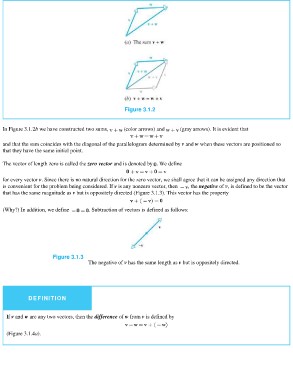
Figure 3.1.2

In Figure 3.1.2b we have constructed two sums,  (color arrows) and  (gray arrows). It is evident that

and that the sum coincides with the diagonal of the parallelogram determined by v and w when these vectors are positioned so
that they have the same initial point.

The vector of length zero is called the zero vector and is denoted by . We define

for every vector v. Since there is no natural direction for the zero vector, we shall agree that it can be assigned any direction that
is convenient for the problem being considered. If v is any nonzero vector, then , the negative of v, is defined to be the vector
that has the same magnitude as v but is oppositely directed (Figure 3.1.3). This vector has the property

(Why?) In addition, we define  . Subtraction of vectors is defined as follows:

                         Figure 3.1.3
                                            The negative of v has the same length as v but is oppositely directed.

            DEFINITION
If v and w are any two vectors, then the difference of w from v is defined by
(Figure 3.1.4a).

