


Page 186 - Elementary_Linear_Algebra_with_Applications_Anton__9_edition
P. 186
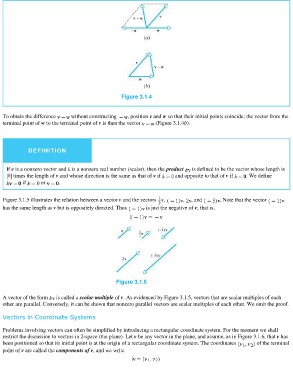
Figure 3.1.4

To obtain the difference  without constructing , position v and w so that their initial points coincide; the vector from the

terminal point of w to the terminal point of v is then the vector  (Figure 3.1.4b).

DEFINITION

If v is a nonzero vector and k is a nonzero real number (scalar), then the product is defined to be the vector whose length is

times the length of v and whose direction is the same as that of v if       and opposite to that of v if . We define

if or .

Figure 3.1.5 illustrates the relation between a vector v and the vectors ,  , , and                     . Note that the vector

has the same length as v but is oppositely directed. Thus          is just the negative of v; that is,

                               Figure 3.1.5

A vector of the form is called a scalar multiple of v. As evidenced by Figure 3.1.5, vectors that are scalar multiples of each
other are parallel. Conversely, it can be shown that nonzero parallel vectors are scalar multiples of each other. We omit the proof.

Vectors in Coordinate Systems

Problems involving vectors can often be simplified by introducing a rectangular coordinate system. For the moment we shall

restrict the discussion to vectors in 2-space (the plane). Let v be any vector in the plane, and assume, as in Figure 3.1.6, that v has

been positioned so that its initial point is at the origin of a rectangular coordinate system. The coordinates  of the terminal

point of v are called the components of v, and we write

