


Page 324 - Elementary_Linear_Algebra_with_Applications_Anton__9_edition
P. 324
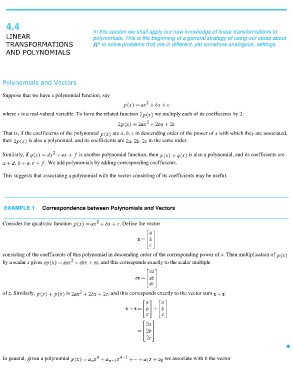
4.4                              In this section we shall apply our new knowledge of linear transformations to
                                 polynomials. This is the beginning of a general strategy of using our ideas about
LINEAR
TRANSFORMATIONS                      to solve problems that are in different, yet somehow analogous, settings.
AND POLYNOMIALS

Polynomials and Vectors

Suppose that we have a polynomial function, say

where x is a real-valued variable. To form the related function  we multiply each of its coefficients by 2:

That is, if the coefficients of the polynomial are a, b, c in descending order of the power of x with which they are associated,
then is also a polynomial, and its coefficients are , , in the same order.

Similarly, if                          is another polynomial function, then      is also a polynomial, and its coefficients are
      ,,             . We add polynomials by adding corresponding coefficients.

This suggests that associating a polynomial with the vector consisting of its coefficients may be useful.

EXAMPLE 1 Correspondence between Polynomials and Vectors

Consider the quadratic function                  . Define the vector

consisting of the coefficients of this polynomial in descending order of the corresponding power of x. Then multiplication of

by a scalar s gives              , and this corresponds exactly to the scalar multiple

of z. Similarly,     is          , and this corresponds exactly to the vector sum :

In general, given a polynomial                                        we associate with it the vector

