


Page 326 - Elementary_Linear_Algebra_with_Applications_Anton__9_edition
P. 326
Calculus Required

Differentiation takes polynomials of degree n to polynomials of degree , so the corresponding transformation on vectors must

take vectors in        to vectors in . Hence, if differentiation corresponds to a linear transformation, it must be represented by a

matrix. For example, if p is an element of —that is,

for some real numbers a, b, and c—then

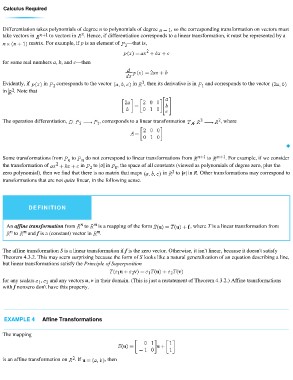
Evidently, if in corresponds to the vector      in , then its derivative is in and corresponds to the vector
in . Note that

The operation differentiation,          , corresponds to a linear transformation  , where

Some transformations from to do not correspond to linear transformations from to . For example, if we consider

the transformation of           in to in , the space of all constants (viewed as polynomials of degree zero, plus the

zero polynomial), then we find that there is no matrix that maps    in to in R. Other transformations may correspond to

transformations that are not quite linear, in the following sense.

DEFINITION

An affine transformation from to is a mapping of the form                         , where T is a linear transformation from
    to and f is a (constant) vector in .

The affine transformation S is a linear transformation if f is the zero vector. Otherwise, it isn't linear, because it doesn't satisfy
Theorem 4.3.2. This may seem surprising because the form of S looks like a natural generalization of an equation describing a line,
but linear transformations satisfy the Principle of Superposition

for any scalars , and any vectors u, v in their domain. (This is just a restatement of Theorem 4.3.2.) Affine transformations
with f nonzero don't have this property.

EXAMPLE 4 Affine Transformations
The mapping

is an affine transformation on . If     , then

