


Page 329 - Elementary_Linear_Algebra_with_Applications_Anton__9_edition
P. 329
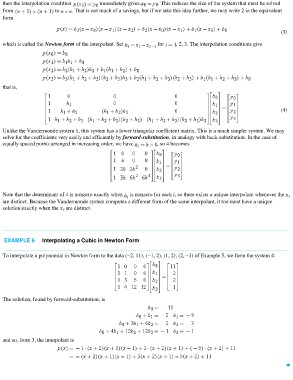
then the interpolation condition  immediately gives          . This reduces the size of the system that must be solved

from      to . That is not much of a savings, but if we take this idea further, we may write 2 in the equivalent

form

                                                                                                                                   (3)

which is called the Newton form of the interpolant. Set      for , 2, 3. The interpolation conditions give

that is,

                                                                                                                                   (4)

Unlike the Vandermonde system 1, this system has a lower triangular coefficient matrix. This is a much simpler system. We may

solve for the coefficients very easily and efficiently by forward-substitution, in analogy with back-substitution. In the case of

equally spaced points arranged in increasing order, we have  , so 4 becomes

Note that the determinant of 4 is nonzero exactly when is nonzero for each i, so there exists a unique interpolant whenever the
are distinct. Because the Vandermonde system computes a different form of the same interpolant, it too must have a unique
solution exactly when the are distinct.

EXAMPLE 6 Interpolating a Cubic in Newton Form
To interpolate a polynomial in Newton form to the data (−2, 11), (−1, 2), (1, 2), (2, −1) of Example 5, we form the system 4:

The solution, found by forward-substitution, is

and so, from 3, the interpolant is

