


Page 331 - Elementary_Linear_Algebra_with_Applications_Anton__9_edition
P. 331
which checks.

There is another approach to solving 1, based on the Fast Fourier Transform, that also requires an amount of work proportional to

. The point for now is to see that the use of linear transformations on  can help us perform computations involving

polynomials. The original problem—to fit a polynomial of minimum degree to a set of data points—was not couched in the
language of linear algebra at all. But rephrasing it in those terms and using matrices and the notation of linear transformations on

       has allowed us to see when a unique solution must exist, how to compute it efficiently, and how to transform it among

various forms.

Exercise Set 4.4

       Click here for Just Ask!

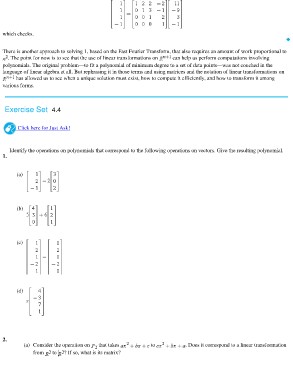
   Identify the operations on polynomials that correspond to the following operations on vectors. Give the resulting polynomial.
1.

       (a)

(b)

(c)

(d)

2.                                                   to . Does it correspond to a linear transformation
           (a) Consider the operation on that takes

     from to ? If so, what is its matrix?

