


Page 334 - Elementary_Linear_Algebra_with_Applications_Anton__9_edition
P. 334
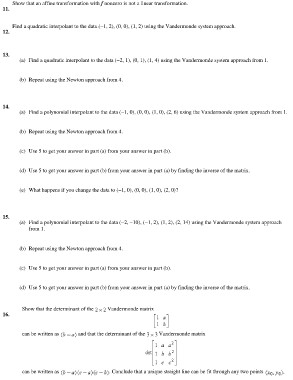
Show that an affine transformation with f nonzero is not a linear transformation.
11.

     Find a quadratic interpolant to the data (−1, 2), (0, 0), (1, 2) using the Vandermonde system approach.
12.

13.
         (a) Find a quadratic interpolant to the data (−2, 1), (0, 1), (1, 4) using the Vandermonde system approach from 1.

         (b) Repeat using the Newton approach from 4.

14.
         (a) Find a polynomial interpolant to the data (−1, 0), (0, 0), (1, 0), (2, 6) using the Vandermonde system approach from 1.

         (b) Repeat using the Newton approach from 4.

         (c) Use 5 to get your answer in part (a) from your answer in part (b).

         (d) Use 5 to get your answer in part (b) from your answer in part (a) by finding the inverse of the matrix.

         (e) What happens if you change the data to (−1, 0), (0, 0), (1, 0), (2, 0)?

15.
         (a) Find a polynomial interpolant to the data (−2, −10), (−1, 2), (1, 2), (2, 14) using the Vandermonde system approach
              from 1.

         (b) Repeat using the Newton approach from 4.

         (c) Use 5 to get your answer in part (a) from your answer in part (b).

         (d) Use 5 to get your answer in part (b) from your answer in part (a) by finding the inverse of the matrix.

          Show that the determinant of the  Vandermonde matrix
16.

can be written as  and that the determinant of the Vandermonde matrix

can be written as                           . Conclude that a unique straight line can be fit through any two points              ,

